Free Agency Templates: 9 Templates for Projects, Meetings and Clients
By OngridWork · 23 November 2026 · 4 min read
In short
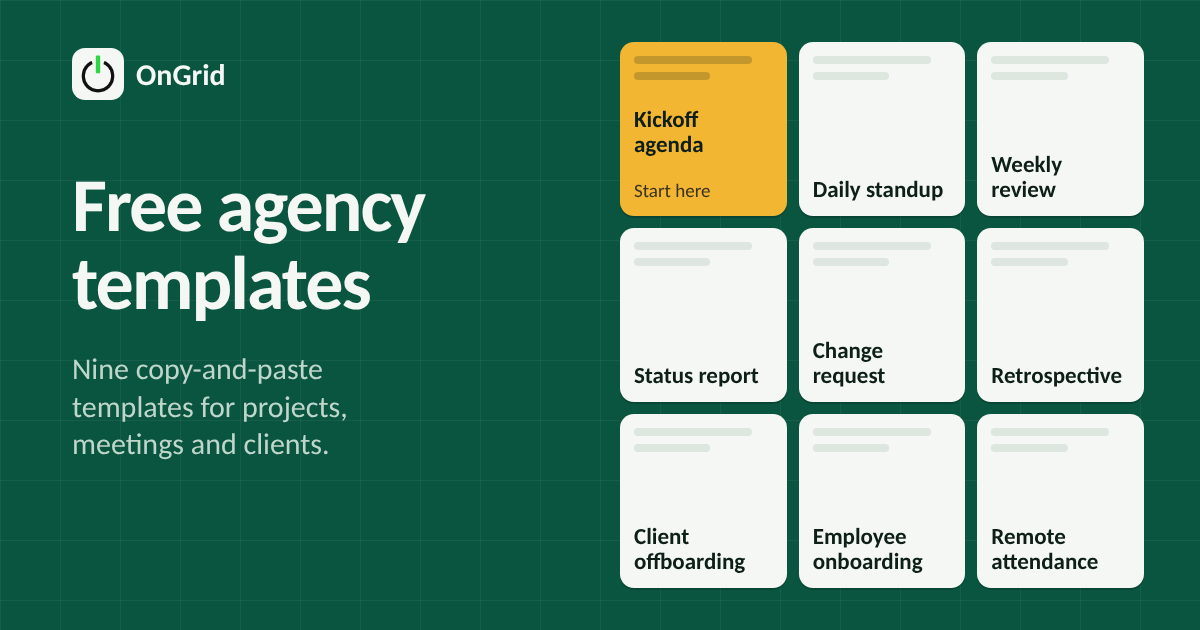
- Agency templates are reusable documents that standardise how your team starts projects, runs client work, finishes projects and manages people. This page lists nine free ones: kickoff agenda, daily standup, weekly review, client status report, change request, retrospective, client offboarding, employee onboarding and remote attendance policy. Each links to a full guide.
Most agencies reinvent the same documents for every client: a kickoff agenda, a weekly update, a change request form. Good agency templates save that time and make your quality consistent from one project to the next. This page collects nine free agency templates, organised by where they fit in a client project, each with a link to the full guide so you can copy the version you need.
What are agency templates and why use them?
Agency templates are reusable documents and checklists that standardise recurring work: meetings, reports, approvals and handovers. They matter because agencies repeat the same processes across many clients, and without a template every project team invents its own version. A template cuts preparation time, reduces missed steps, and makes new hires productive sooner.
Which agency template should you use?
Pick by the situation you are in.
Situation | Template | Time it takes |
|---|---|---|
A new client project is starting | Client kickoff meeting agenda | 60 minutes |
Your team needs a daily check-in | Daily standup template | 10 minutes |
You want to plan the week ahead | Weekly agency review agenda | 45 minutes |
A client keeps asking for updates | Client status report template | 5 minutes a week |
A client asks for extra work | Change request template | 10 minutes per request |
A project has just finished | Project retrospective template | 60 minutes |
A client is leaving | Client offboarding checklist | 2 to 4 weeks |
Someone new is joining | Employee onboarding checklist | 90 days |
Your team works remotely | Remote attendance policy | One page |
Which templates help you start a client project?
Client kickoff meeting agenda. A 60-minute agenda with seven timed sections covering goals, scope, timeline, communication and approvals. Use it for the first meeting of every project, so both sides agree what is in and out of scope before work begins. Get the client kickoff meeting agenda.
Which templates help you run client work?
Daily standup template. Five prompts that keep a standup to 10 minutes, including a capacity check most templates skip. Use it every working day. Get the daily standup template.
Weekly agency review agenda. A 45-minute agenda that looks ahead at deadlines, workload, approvals and revenue. Use it once a week with leads and account managers. Get the weekly review agenda.
Client status report template. A one-page weekly update with five sections, ending with one dated request. Use it for every active client. Get the client status report template.
Change request template. A one-page form for pricing and approving extra work, with a five-step flow that stops scope creep. Use it whenever a client asks for something outside the agreed scope. For background on how often scope creep happens, see PMI's article on rising scope creep. Get the change request template.
Which templates help you finish a project?
Project retrospective template. A 60-minute agenda with six sections that turns each finished project into three owned actions. The idea comes from agile teams, and Scrum.org explains the original practice. Get the project retrospective template.
Client offboarding checklist. A six-step checklist for ending an engagement cleanly: closing work, handing over files, revoking access and keeping the door open for referrals. Use it whenever a client leaves or a contract ends. Get the client offboarding checklist.
Which templates help you manage your team?
Employee onboarding checklist. A five-stage checklist from before day one to day 90, with owners for each stage. Use it for every hire. Gallup's work on onboarding is a good place to start if you want the research, and its article on onboarding new employees is a useful read. Get the employee onboarding checklist.
Remote attendance policy. A one-page policy covering core hours, daily check-in, leave requests and what you do not track. Use it for remote and hybrid teams. If you want it in a tool, see OnGrid's attendance and leave management. Get the remote attendance policy.
How do you adapt these templates to your agency?
Start with the template as written, use it twice, then edit. Change the timings to fit your team size, rename the sections to match how you talk, and delete anything nobody uses. Keep one master copy and ask team leads to suggest changes, so the template improves without drifting into five different versions.
Where should you store your templates?
In one shared place that everyone can find without asking. A shared folder, a wiki or a knowledge base works, provided every template has an owner and a "last updated" date. If your team uses OnGrid, the knowledge base is the natural home for them, next to your projects and approvals. Templates that live in someone's personal drive are forgotten within months.
What mistakes should you avoid?
Using templates as rigid rules. They are starting points, so adapt them.
Having too many. Start with three: kickoff, status report and change request.
Never updating them. Review each template after every project.
Hiding them. A template nobody can find does not get used.
Skipping the owner. Every template needs one person responsible for keeping it current.
Frequently asked questions
What are agency templates?
Agency templates are reusable documents for recurring agency work, such as kickoff agendas, status reports, change requests and onboarding checklists.
Which agency templates should a new agency start with?
Start with three: a client kickoff agenda, a weekly client status report and a change request form. Together they cover most of the problems new agencies hit with scope and communication.
Are these agency templates free to use?
Yes. Copy and adapt them for your own agency. If you share them publicly, credit OnGrid and link back to this page.
How often should you update your agency templates?
Review each one after every project or at least once a quarter, and update the "last updated" date when you change it.
Can small agencies use the same templates as large ones?
Yes, with fewer sections and shorter meetings. A team of five can run a 5-minute standup and a 30-minute weekly review using the same templates.