Client Offboarding Checklist for Agencies: Exit Cleanly and Keep the Door Open
By Ongrid.work · 17 November 2026 · 4 min read
In short
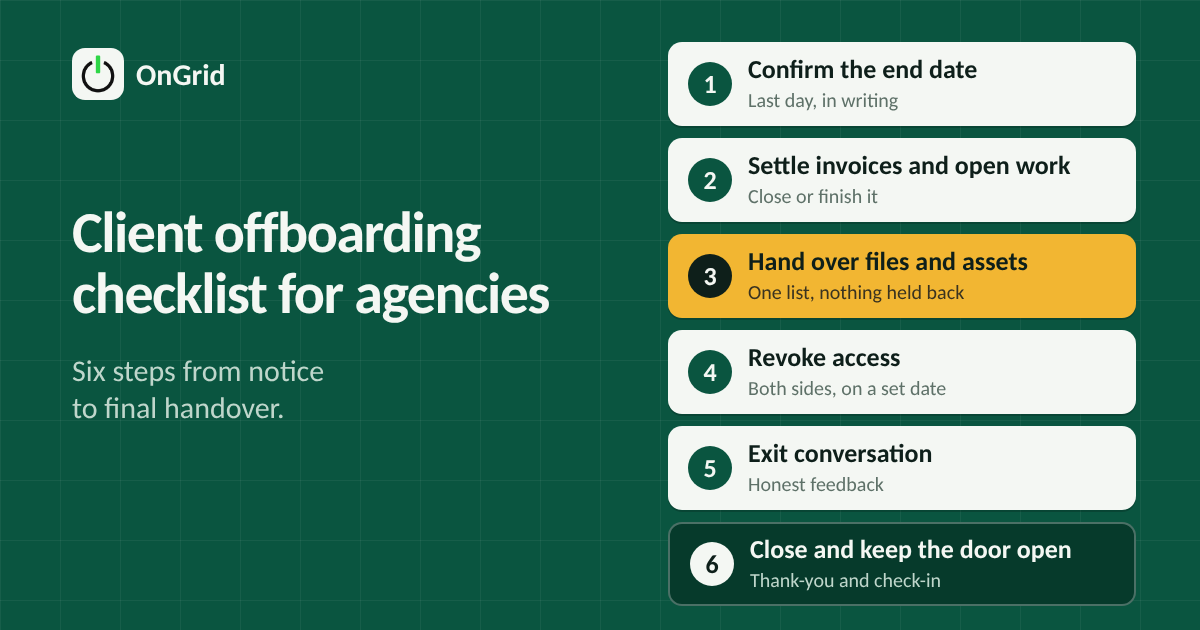
- A client offboarding checklist for agencies covers six steps: confirm the end date, settle invoices and open work, hand over files and assets, revoke access, hold an exit conversation, and close with a thank-you. Start the day you get notice, give the client a written handover, and leave the door open for referrals and future work.
Most agencies spend weeks on a kickoff and almost no time on the end of a client relationship. A client offboarding checklist for agencies fixes that by turning the exit into a short, repeatable process: close open work, hand over files, revoke access and leave on good terms. This post gives you a client offboarding checklist for agencies with a six-step timeline and a template you can copy.
What is client offboarding in an agency?
Client offboarding is the structured process of ending a client engagement: finishing or closing open work, transferring files and accounts, removing system access, settling payments and recording what you learned. It applies whether the client leaves, a contract ends, or you decide to part ways. A clean offboarding protects both sides and leaves the relationship in a state where the client would recommend you.
Why does client offboarding matter?
Because how a relationship ends is what the client remembers, and because lost clients often become referrers if the exit goes well. Harvard Business Review has noted that acquiring a new customer can cost anywhere from five to 25 times more than retaining an existing one, although that range is a rule of thumb and not a precise measurement. The point for agencies holds either way: a client who leaves happily may return, refer you or give a testimonial, and a client who leaves badly will not. localiq
It also reduces risk. Old logins left open, files with no clear owner and unpaid invoices all become problems months later.
When should offboarding start?
On the day you receive or give notice, not on the last day of the contract. Check the notice period in your agreement, then work backwards: if you have 30 days, you need a handover date, a final invoice date and an access-removal date inside that window.
What should the client offboarding checklist for agencies include?
Use six steps, in this order.
Step | What to do | When |
|---|---|---|
1. Confirm the end date | Agree the last working day, the handover date and who is the contact on each side, in writing | Day 1 |
2. Settle invoices and open work | Finish or formally close in-progress work, and send the final invoice | Week 1 |
3. Hand over files and assets | Give the client everything they own, with a list | Week 2 |
4. Revoke access and transfer ownership | Remove your team from the client’s accounts and the client from yours | Last week |
5. Hold an exit conversation | Ask what worked and what did not | Last week |
6. Close and keep the door open | Send a thank-you, archive the project and book a check-in | Final day |
Open work is where most arguments start. If something is half-finished, agree in writing whether it will be completed, paid for as-is or dropped. Our guide to scope creep in agencies explains how to price and approve anything extra before the contract ends.
Which files and assets should you hand over?
Everything the client paid for, and anything that belongs to them. Provide a single handover list with links and format notes. A typical agency handover includes:
Working files in editable formats, not only exports
Brand assets, fonts and design source files, as agreed in the contract
Content such as copy, images and videos produced for them
Account ownership for ad accounts, analytics, social profiles and domains
Documentation covering how things are set up and where logins are stored
Never hold files back over a payment dispute. It damages your reputation and may breach your contract. Settle the invoice question separately.
How do you revoke access safely?
Remove access on a set date and keep a record of it. Go through this list:
Remove your team from the client’s social, ad, analytics and hosting accounts.
Remove the client’s users from your shared folders and project tools.
Change any shared passwords you created for the client.
Delete or transfer login details from your password manager.
Confirm in writing that access has been removed on both sides.
What should you ask in an exit conversation?
Keep it to a 20-minute call with open questions: What did we do well? What should we have done differently? What made you decide to end the engagement? Would you work with us again, and under what conditions? Write the answers down. Honest exit feedback is more useful than a satisfaction score, and you can feed it into your own project retrospective.
How do you leave the door open?
Send a short thank-you note on the last day, ask permission to mention the work in your portfolio or a case study, and ask for a testimonial if the engagement went well. Add a calendar reminder to check in after three months. If you have been sending a weekly client status report, send a final summary report as your closing document.
Copy-and-paste client offboarding checklist
CLIENT OFFBOARDING: [Client / Project]
Notice received: [date]    Last working day: [date]
Contact (client) / Owner (agency):

1. End date confirmed in writing
2. Open work
   Item / complete, close or drop / owner / date:
   Final invoice sent: [date]    Paid: [date]
3. Handover
   Files / brand assets / content / documentation: [link]
   Account ownership transferred: [list]
4. Access
   Removed from client accounts: [date]
   Client removed from our tools: [date]
   Shared passwords changed: [date]
5. Exit conversation held: [date]
   Notes:
6. Close
   Thank-you sent: [date]
   Portfolio / testimonial permission: Yes / No
   Check-in booked for: [date]
What mistakes should you avoid?
Starting on the last day. You will not finish the handover.
Leaving access open. Old logins are a security risk and a source of confusion.
Holding files hostage. It turns a normal exit into a dispute.
Skipping the exit conversation. It is the cheapest source of honest feedback you will get.
Burning the relationship. A polite, organised exit costs little and keeps referrals possible.
Frequently asked questions
What is client offboarding?
Client offboarding is the structured process of ending a client engagement, covering open work, file handover, access removal, final payment and feedback.
How long does client offboarding take?
Most agency offboardings take two to four weeks. Short projects can finish in a few days, and large retainers may need longer.
Who should lead client offboarding in an agency?
The account manager or project lead who owns the client relationship, supported by whoever manages access and billing.
Should you offboard a client who is not paying?
Yes, but follow your contract. Pause work in writing, send the final invoice and state when access will be removed if payment is not made. For serious cases, get legal advice, since this article is not legal advice.
Can you ask a departing client for a testimonial?
Yes, if the work went well. Ask politely at the end, and make it easy by offering two or three questions they can answer in a few lines.