Agency Client Kickoff Meeting Agenda: A 60-Minute Template
By Ongrid.work · 13 November 2026 · 4 min read
In short
- An agency client kickoff meeting agenda should take 60 minutes and cover seven things: introductions, goals, scope, timeline, how you will communicate and approve work, what you need from the client, and next steps with owners. Send it in advance, and finish by writing down every decision and who owns it.
An agency client kickoff meeting agenda is the difference between a project that starts clearly and one that spends its first month untangling what everyone thought was agreed. Most agencies treat the kickoff as a friendly hello. The ones that treat it as a working session avoid the arguments about scope, delays and late feedback that show up three weeks later.
This post gives you a 60-minute agenda, a preparation checklist and a template you can copy.
What is a client kickoff meeting?
A client kickoff meeting is the first working session between your agency and a new client, or between you and an existing client at the start of a new project. Its job is to agree on goals, scope, timelines, who does what, and how you will communicate. It is not a sales pitch and not a status update. By the end, both sides should know exactly what happens next.
Why does the kickoff meeting matter so much?
Most delivery problems start with a gap in the first conversation: unclear goals, unstated assumptions, or no agreement on who approves what. Research from the Project Management Institute in 2013 found that fewer than two-thirds of projects meet their goals and business intent, and about 17 percent fail outright. That is older data, but the lesson holds: projects go wrong early, and the kickoff is your best chance to prevent it.
What should the agency client kickoff meeting agenda include?
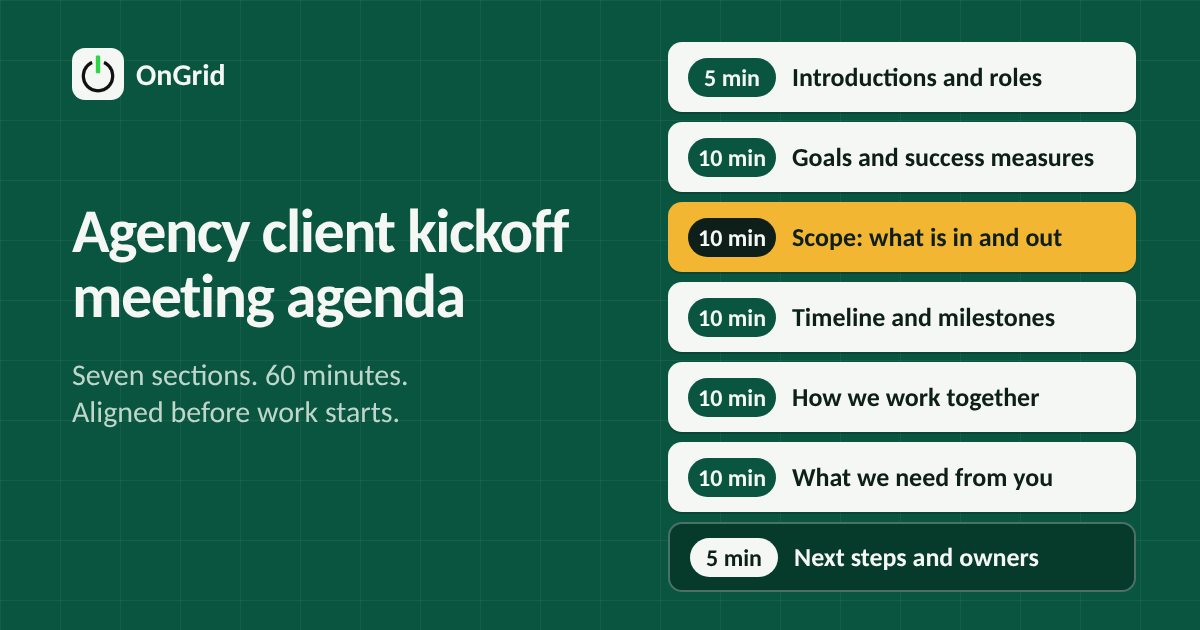
Use seven sections with fixed time limits. They add up to 60 minutes.
Time | Section | What to cover |
|---|---|---|
5 min | Introductions and roles | Who is on each side, who makes decisions, and who is the main contact |
10 min | Goals and success measures | What the client wants, how you will both know it worked |
10 min | Scope: what is in and out | Deliverables included, what is not included, and how changes are handled |
10 min | Timeline and milestones | Key dates, review points and the final deadline |
10 min | How we work together | Communication channel, report day, and the approval process |
10 min | What we need from you | Logins, brand files, content and a named approver, each with a date |
5 min | Next steps and owners | Read back every decision with a name and a due date |
The scope section is the one agencies rush, and it causes the most disputes. Spend the full ten minutes and write down what is out of scope, not only what is in.
How do you prepare for the kickoff meeting?
1. Send the agenda two days ahead. Include the seven sections so the client knows what to bring.
2. Review the brief and proposal. Know what was promised so you can confirm it, not rediscover it.
3. Draft a one-page scope summary. Walking through a draft is faster than building one live.
4. Prepare a timeline with dates. Ranges like “a few weeks” invite disagreement.
5. Invite the right people. Include the client’s decision-maker, not just their day-to-day contact. If the person who approves work is absent, you will meet again.
What should you ask the client in the meeting?
These questions surface problems early:
What does success look like three months from now?
Who needs to approve each deliverable, and how long will approval usually take?
What has gone wrong with agencies or vendors before?
Are there any fixed dates, such as a launch or event, that we cannot move?
What is outside the scope that people might expect to be included?
How should you agree on approvals and communication?
Decide this in the room, not by email later. Agree on one channel for day-to-day messages, one day for the weekly update, and one named approver per deliverable with a turnaround time such as two working days. Our client approval process post explains how to set this up, and the client status report template shows what the weekly update should contain.
What happens after the meeting?
Send a recap within 24 hours. It should list the goals, scope (in and out), timeline, communication rules, what the client owes you with dates, and the next steps with owners. Ask the client to reply “confirmed” or point out any corrections. That reply is your record if anything is questioned later. Once work begins, a short weekly review keeps your side on track.
Copy-and-paste kickoff meeting template
KICKOFF MEETING: [Client / Project], [Date, IST]
Attendees:

1. Introductions and roles (5 min)
   Main contact / decision-maker:

2. Goals and success measures (10 min)
   Goal:
   How we will measure it:

3. Scope (10 min)
   In scope:
   Out of scope:
   How changes are handled:

4. Timeline and milestones (10 min)
   Key dates:

5. How we work together (10 min)
   Channel / report day / approver and turnaround:

6. What we need from you (10 min)
   Item / owner / due date:

7. Next steps and owners (5 min)
   Decision / owner / due date:
What mistakes should you avoid?
Skipping out-of-scope. If you do not name what is excluded, the client will assume it is included.
Meeting without the decision-maker. Approvals stall when the person who decides was never in the room.
Leaving dates vague. “Soon” and “next week” mean different things to each side.
Not sending a recap. A verbal agreement is easy to forget and hard to prove.
Doing all the talking. The client should speak for at least half the meeting.
Frequently asked questions
How long should a client kickoff meeting be?
Sixty minutes is enough for most agency projects. A small project can finish in 30 to 45 minutes, and a complex one may need 90, or a second session.
Who should attend the kickoff meeting?
The account manager, the project lead and one or two people doing the work, plus the client’s main contact and their decision-maker.
What is the difference between a kickoff meeting and an onboarding call?
Onboarding collects information and sets up access for a new client. A kickoff aligns both sides on a specific project’s goals, scope and timeline. For new clients you may run both, back to back.
Should the kickoff meeting be in person or on a video call?
Either works. A video call is easier to schedule and record. For large or high-value projects, an in-person meeting builds trust faster.
What should we send the client after the kickoff?
A written recap within 24 hours, covering goals, scope, timeline, communication rules, client requirements with dates, and next steps with owners.