Agency Pricing Models: Hourly, Project, Retainer or Value-Based? How to Choose and Set Your Price
By OngridWork · 25 November 2026 · 5 min read
In short
- The main agency pricing models are hourly, fixed project fee, monthly retainer, value-based and productised packages. Surveys disagree on which is most common, but retainers and project fees dominate. Choose by how predictable the scope is, then set the price from your loaded hourly cost, a target margin and a buffer for revisions.
Most agencies set prices by looking at what competitors charge, adding a bit, and hoping the project fits. That is why so many busy agencies still earn thin margins. Choosing between agency pricing models is the first step, and setting the number from your own costs is the second. This guide compares the main agency pricing models, explains when each one works, and shows how to build a price in rupees from your real costs.
What are agency pricing models?
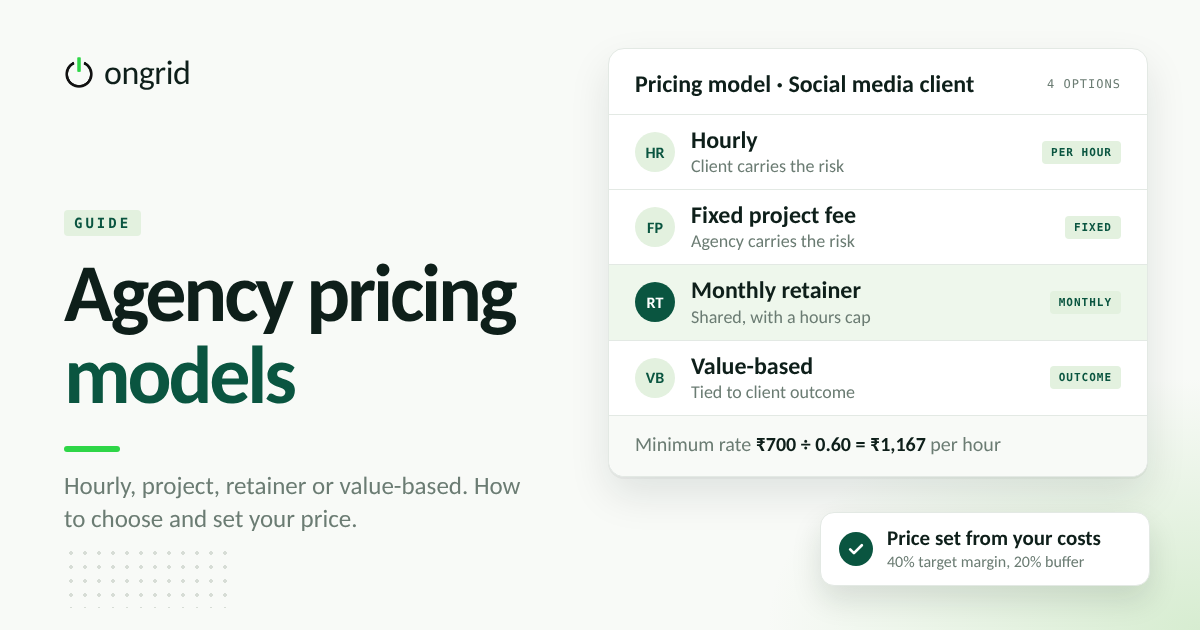
Agency pricing models are the structures agencies use to charge clients: by the hour, by the project, by a recurring monthly fee, by the value delivered, or by a fixed package. The model decides who carries the risk. In an hourly model the client carries it, because more hours mean a bigger bill. In a fixed-fee model the agency carries it, because extra hours are unpaid. Choosing well is one of the biggest levers on your agency profit margin.
Which pricing models do agencies use most?
Retainers and fixed project fees lead, but the numbers depend on the survey, the agency type and how the question was asked. Promethean Research found that marketing agencies lean toward retainers at 45 percent, while design agencies favour project-based pricing at 41 percent. A separate survey by SE Ranking and Duda found that 53 percent of participating agencies prefer monthly retainers over other models. A third, by SoDa and Productive, reports that project-based models account for roughly half of agency revenue and retainers about 44 percent, with most agencies using several models. Pricing Models Follow Agency Archetypes +2
Two points follow. First, most agencies mix models, so you do not have to choose one. Second, these are mainly US and global surveys of agencies in specific niches, so use them as context and not as an Indian benchmark.
How do the five main pricing models compare?
Model | How it works | Works best for | Main risk |
|---|---|---|---|
Hourly | Client pays for hours worked | Unclear scope, support and consulting | Revenue is capped by hours, and clients question every hour |
Fixed project fee | One price for a defined deliverable | Websites, branding, campaigns with clear scope | Scope creep eats the margin |
Monthly retainer | Recurring fee for an agreed set of services | Ongoing work such as social media, SEO and content | Unclear limits lead to unlimited requests |
Value-based | Price tied to the outcome for the client | Experienced agencies with proof of results | Hard to estimate, and harder to sell |
Productised package | Fixed scope and price for a repeatable service | Agencies with one or two services they deliver often | Less flexible for custom needs |
Value-based pricing gets a lot of attention, but the data is cautious. In Promethean's 2025 survey, only 18 percent of agencies used value-based pricing, and that group underperformed agencies using more standard models. It can work, but it needs strong positioning and a track record. kit
How do you choose a pricing model?
Match the model to how predictable the work is:
Scope is clear and bounded: use a fixed project fee, and protect it with a written scope and change request process.
Scope is unclear or evolving: use hourly or a capped-hours arrangement until the scope settles.
Work is ongoing and repeats monthly: use a retainer with defined deliverables.
You deliver the same service again and again: productise it and sell it as a package.
You have proof of outcomes and clients who value them: test value-based pricing on one or two accounts first.
Most agencies end up with a hybrid, such as a retainer for ongoing work plus fixed fees for projects.
How do you set the price from your costs?
Build the number from your own costs, not from competitors. Here is a four-step method with an example in rupees.
Work out your loaded hourly cost. Add salary and a share of overheads (rent, tools, admin) and divide by billable hours. Say this is ₹700 per hour.
Choose a target margin. Say you want 40 percent.
Calculate the minimum rate. Divide cost by (1 − margin): ₹700 ÷ 0.60 = about ₹1,167 per hour.
Estimate hours with a buffer. A project estimated at 80 hours plus a 20 percent buffer for revisions is 96 hours. Fee = 96 × ₹1,167 ≈ ₹1,12,000.
If the project takes 96 hours, the margin is 40 percent. If scope creep pushes it to 120 hours, the cost rises to ₹84,000 and the margin falls to about 25 percent. That gap is why the buffer matters, and why you also need a scope creep process.
How do you structure a retainer so it stays profitable?
A retainer fails when the scope is vague. Define these five things in writing:
Deliverables per month, such as 12 posts and 2 reports, not "social media support"
Hours cap or fair-use limit, so requests cannot grow without a conversation
Revision rounds included in each deliverable
What is extra, and how it is priced and approved
Review point, so you can adjust the fee after three months
Send a short weekly client status report, so the client sees the value they are getting for the monthly fee.
How do you present your price to a client?
Offer two or three options instead of one number. A basic, standard and premium package lets the client choose the scope that fits their budget, and it moves the conversation from "is this too expensive?" to "which option?". State what is included and what is not, whether GST is extra, and the payment terms. For larger projects, ask for an advance before work begins. For India, TDS may apply depending on the service and the client, so confirm the treatment with your accountant. Set expectations at the start, using your client kickoff meeting agenda.
When should you raise your prices?
Raise prices when you are consistently busy, when your margin is below target, or when your costs have gone up. Increase rates for new clients first, since you can do that immediately. For existing clients, give 30 to 60 days' notice in writing and explain the reason briefly. Review your numbers after each project in a retrospective and compare planned and actual hours, which tells you whether your estimates need to change.
Copy-and-paste pricing worksheet
PRICING WORKSHEET: [Service / Project]

1. Loaded cost per hour (salary + overhead share) / billable hours: ₹
2. Target margin: %
3. Minimum rate = cost / (1 - margin): ₹ per hour
4. Estimated hours:
   Buffer for revisions (15 to 25%):
   Total hours:
5. Fee = total hours x minimum rate: ₹
   GST: extra / included
6. Scope included:
   Scope not included:
   Revision rounds:
7. Pricing model: Hourly / Fixed / Retainer / Value-based / Package
8. Payment terms (advance, milestones, due date):
9. Review date:
What pricing mistakes should you avoid?
Copying competitors. Their costs and goals are not yours.
Pricing without a buffer. Revisions always happen.
Selling a retainer with no limits. It becomes unpaid project work.
Discounting without trading scope. If the price drops, the scope should too.
Never revisiting prices. Costs rise every year, and your rates should too.
Frequently asked questions
What are the most common agency pricing models?
The most common are hourly rates, fixed project fees, monthly retainers, value-based pricing and productised packages. Most agencies use more than one.
Which pricing model is the most profitable for an agency?
There is no single answer. Retainers give predictable revenue, and fixed fees can be very profitable when scope is controlled. Value-based pricing has high potential but needs strong proof of results. What matters most is pricing from your own costs and managing scope.
How do you calculate an agency hourly rate?
Divide your loaded hourly cost (salary plus a share of overheads) by one minus your target margin. For example, a cost of ₹700 per hour and a 40 percent target margin gives a minimum rate of about ₹1,167 per hour.
Is a retainer better than project-based pricing?
Retainers suit ongoing work and give steady income. Project fees suit one-off work with a clear scope. Many agencies offer both, depending on the client.
How should Indian agencies handle GST in pricing?
State clearly whether your quote includes or excludes GST, and show it separately on invoices. Confirm the correct treatment, including any TDS, with your accountant.