Client Status Report Template for Agencies: One Page, Five Minutes
By Ongrid.work · 3 November 2026 · 3 min read
In short
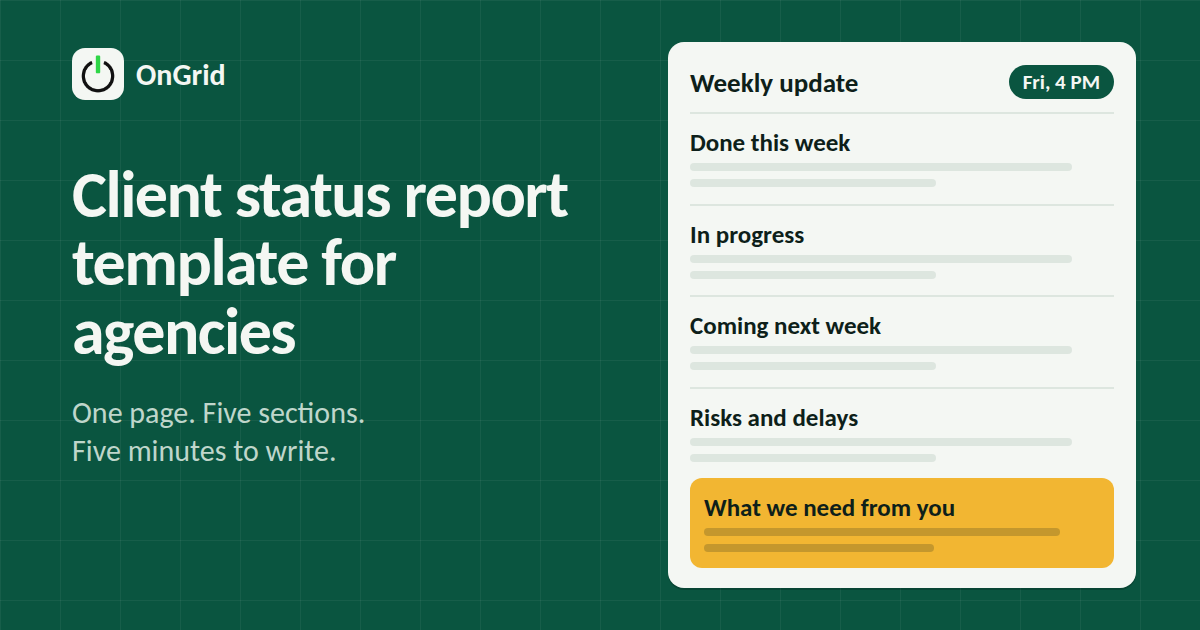
- A client status report template for agencies should fit on one page and answer five things: what was completed, what is in progress, what is coming next, what is at risk, and what you need from the client. Send it on the same day every week, keep it under 200 words, and always end with one clear request.
A client status report template for agencies saves you from the two worst client emails: “Any update?” and “Why did nobody tell me this was delayed?” Most agencies only send a report when something goes wrong, which means the client reads every update as bad news.
A steady, short weekly report fixes that. This post gives you a one-page template, a worked example, and a simple routine so the report takes five minutes to write instead of an hour.
Why do agencies need a client status report?
Clients cannot see the work happening. Between kickoff and delivery, a status report is the only proof that progress is real. It also protects you: when a client asks why something is late, a record of earlier updates and open requests shows exactly where the delay started.
Communication also matters beyond keeping clients calm. Research from the Project Management Institute in 2013 found that 56 percent of the dollars spent on projects are at risk due to ineffective communications, which is a good reminder that regular, clear updates are part of delivery, not an extra. pmi
What should a client status report include?
Keep it to five sections. Anything more and clients stop reading.
Section | What to write | Example |
|---|---|---|
1. Done this week | Deliverables completed, in plain language | “Homepage design approved. Three social posts published.” |
2. In progress | Work underway and expected finish date | “Product page copy, due Thursday.” |
3. Coming next week | What starts or ships in the next seven days | “Email campaign draft shared on Tuesday.” |
4. Risks and delays | Anything that may slip, and why | “Logo files are still missing, which may delay the banner set.” |
5. What we need from you | Specific requests with a date | “Please approve the draft by Wednesday, 5 PM IST.” |
The fifth section is the most important one. A report without a request is just information. A report with a dated request moves the project forward.
How long should a client status report be?
Under 200 words for most retainer clients, and no more than one page for project work. If you need more detail, link to it rather than pasting it in. Clients can click through if they want the full picture.
What does a good client status report look like?
Here is a short, real-style example for a social media client:
WEEKLY UPDATE: Brightline Cafe, 14 March

Done
- 3 Instagram posts published, 1 reel edited and approved

In progress
- April menu shoot, creative brief shared, shoot on 19 March

Next week
- Reel 2 draft, carousel for new menu launch

Risks
- Menu prices not confirmed yet. This may delay the launch carousel.

We need from you
- Final menu prices by Tuesday, 5 PM IST
It takes about a minute to read and the client knows exactly what to do next.
How do you write the report in five minutes?
Pick one day and one time. Friday at 4 PM or Monday at 10 AM, and stick to it.
Pull the facts from your task board. Do not rewrite from memory. Completed tasks become “Done” and open tasks become “In progress”.
Write in the client’s language. Say “homepage design approved,” not “UI sprint 3 closed.”
Name the risk early. A delay mentioned on Tuesday is a risk. The same delay mentioned on Friday is a failure.
End with one clear ask. Include a name, a date and a time.
If your team already runs a daily standup and a weekly review meeting, most of the report is already written. The standup gives you blockers, and the weekly review gives you deadlines and capacity. You are just turning them into a client-friendly summary.
Copy-and-paste client status report template
WEEKLY UPDATE: [Client name], [Date]

Done this week
-

In progress (with expected date)
-

Coming next week
-

Risks and delays
-

What we need from you (with date and time)
-
What mistakes should you avoid?
Writing for yourself, not the client. Skip internal jargon and tool names.
Hiding bad news. Clients forgive delays much faster than surprises.
Sending it at random times. An unpredictable report feels like an excuse. A predictable one feels like service.
Burying the request. If the ask is in paragraph four, it will be missed. Put it last, on its own line, in bold.
Skipping the report when nothing happened. A quiet week still deserves a two-line update. Silence makes clients nervous.
Approvals are the most common thing a report needs to chase. If that is your biggest delay, read our guide to the client approval process for agencies.
Frequently asked questions
How often should an agency send a client status report?
Weekly works for most retainer and project clients. For short projects with tight deadlines, send it twice a week. For slow-moving accounts, every two weeks is enough.
What is the difference between a status report and a performance report?
A status report covers progress and next steps on the work. A performance report covers results, such as traffic, leads or sales. Many agencies send both, but separately, since they answer different questions.
Should the status report be an email or a document?
An email works best because clients read it without opening an attachment. Link to a longer document only if the client needs it.
Who should write the client status report?
The account manager or project lead who talks to the client. They know what the client cares about, and the report reads better with one consistent voice.
What should I do if there is nothing to report?
Send a short update anyway. Say that the work is on track, name what comes next, and repeat any open request. A brief message keeps the client confident.