Employee Onboarding Checklist for Agencies: From Before Day One to Day 90
By Ongrid.work · 18 November 2026 · 5 min read
In short
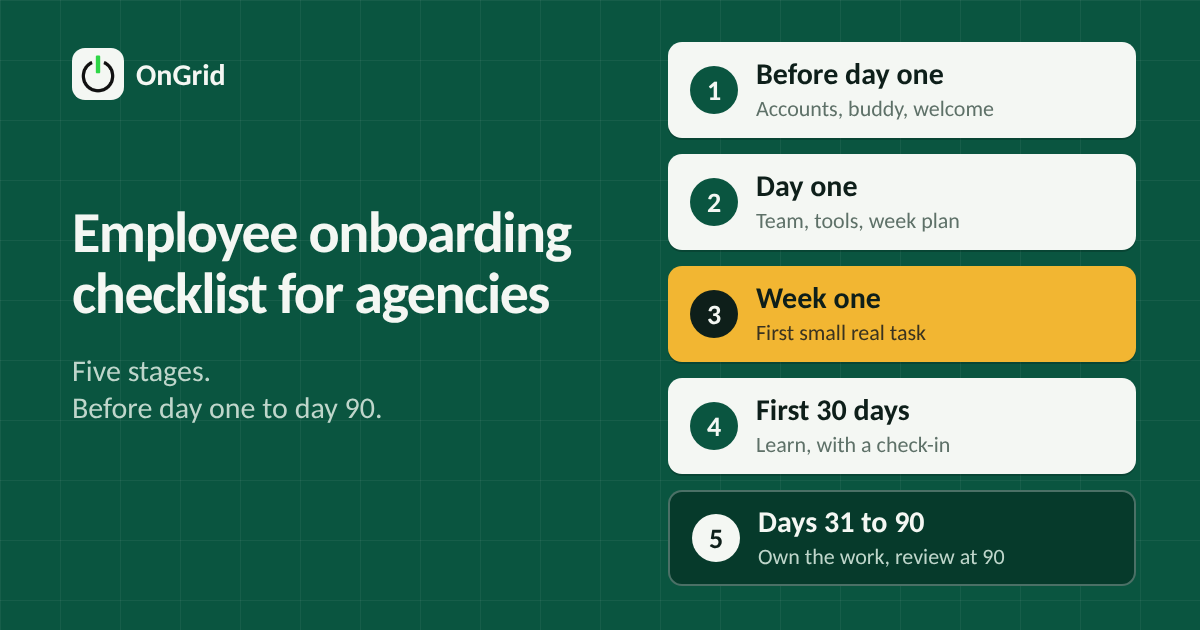
- An employee onboarding checklist for agencies covers five stages: before day one, day one, week one, the first 30 days and days 31 to 90. Prepare accounts and a buddy before the person arrives, give them one small real task in week one, and hold a check-in at 30, 60 and 90 days.
Agencies hire when workload spikes, and the new person is often handed a client brief on day one with no tour, no logins and no idea who to ask. An employee onboarding checklist for agencies fixes that by turning the first 90 days into a clear sequence that any manager can follow. This post gives you an employee onboarding checklist for agencies with five stages, who owns each one, and a template you can copy.
What is employee onboarding in an agency?
Employee onboarding is the process of getting a new hire ready to do their job and feel part of the team. In an agency it covers three things: practical setup (accounts, tools, policies), learning (clients, processes, standards) and belonging (people, culture, feedback). It starts before the first day and continues for roughly three months.
Why does onboarding matter for agencies?
Because agencies cannot afford a slow ramp-up. A new designer or account executive is billable or client-facing within days, and mistakes show up in front of clients. Most companies also do this badly. Gallup finds that only 12 percent of employees strongly agree that their organization does a great job of onboarding new employees. That means most new hires start with some level of confusion, and a simple, written process puts you ahead of most employers. gallup
What should the employee onboarding checklist for agencies include?
Use five stages, each with a clear owner.
Stage | What to do | Owner |
|---|---|---|
Before day one | Sign the offer, prepare accounts and equipment, assign a buddy, send a welcome message and the first-week plan | Manager and ops |
Day one | Welcome, introduce the team, set up tools, explain policies and walk through the week | Manager and buddy |
Week one | Teach how the agency works, introduce key clients, assign one small real task | Buddy |
First 30 days | Build skills, give regular feedback, run a 30-day check-in | Manager |
Days 31 to 90 | Increase responsibility, review progress at 60 and 90 days | Manager |
What should you do before day one?
Remove every avoidable obstacle, so the new hire can start working on day one:
Send a short welcome message with the start time, location or video link, and who they will meet first.
Prepare equipment and logins for email, chat, project tools and shared drives.
Assign a buddy, a peer who answers day-to-day questions without needing to ask a manager.
Collect joining documents and any forms your payroll or HR partner needs, so the first day is not spent on paperwork.
Share the leave and attendance policy in advance. If you manage this in OnGrid, the attendance and leave management setup should be ready before they start.
Write a first-week plan with times, people and the first task.
What should happen on day one?
Keep day one simple and human. Greet them personally, show them where to find everything, introduce the team, and have lunch or a coffee together. Walk through the plan for the week, explain how work is assigned and how updates are shared, and show them your daily routine. If your team runs a daily standup, invite them to the next one so they learn the rhythm early. End the day with a short check-in: “What was confusing? What do you need tomorrow?”
What should week one cover?
Week one is about orientation, not output. Cover these:
How the agency works: services, clients, workflow and where information lives.
Key people and clients: who is who, and which clients they will work with first.
Standards and processes: your SOPs, quality checks and approval steps.
Tools: project board, chat, file storage and time or attendance tools.
One small real task with a clear brief and a deadline within the week, so they finish something and feel useful.
End the week with a 30-minute conversation about what they have learned and what is unclear.
How do you structure the first 30, 60 and 90 days?
Use a simple three-step arc:
Days 1 to 30, learn. The new hire learns clients, tools and standards, and works on supervised tasks. Hold a check-in at day 30.
Days 31 to 60, contribute. They take on tasks independently and join client calls where appropriate. Review progress at day 60.
Days 61 to 90, own. They own a piece of work from start to finish. Hold a 90-day review that covers performance, fit and next goals.
Put these check-ins in the calendar on day one, so they actually happen. You can also review new-hire progress in your weekly review meeting.
Who should own onboarding?
Three people, with different jobs: the manager owns the plan and the check-ins, the buddy answers daily questions, and an ops or HR person owns accounts, policies and paperwork. If one person owns everything, tasks get missed during busy weeks.
How do you onboard freelancers and interns?
Use a lighter version of the same checklist: access, a brief, one contact person, how to submit work and how approvals work. Skip the 90-day plan, and replace it with a clear end date and a check-in halfway through. A short written brief and one named contact prevent most freelancer problems.
Copy-and-paste employee onboarding checklist
NEW HIRE ONBOARDING: [Name], [Role], Start date: [date]
Manager / Buddy / Ops contact:

BEFORE DAY ONE
[ ] Offer signed and joining documents received
[ ] Equipment and accounts ready (email, chat, project tool, drive)
[ ] Buddy assigned
[ ] Welcome message and first-week plan sent
[ ] Leave and attendance policy shared

DAY ONE
[ ] Welcome and team introductions
[ ] Tools set up and tested
[ ] Week plan walked through
[ ] End-of-day check-in done

WEEK ONE
[ ] Agency overview, clients and processes covered
[ ] SOPs shared
[ ] First small task assigned: [task / due date]
[ ] End-of-week conversation held

DAY 30 / 60 / 90
[ ] 30-day check-in: [date]
[ ] 60-day review: [date]
[ ] 90-day review: [date]
Notes and agreed goals:
What mistakes should you avoid?
Starting without logins. Nothing frustrates a new hire more than waiting for access.
Skipping the buddy. Without one, people hesitate to ask basic questions.
Overloading week one. Orientation first, billable work second.
No check-ins. Problems found at 90 days are much harder to fix than those found at 30.
Forgetting to ask for feedback. New hires see your processes with fresh eyes, and it is the best time to learn what is unclear.
Frequently asked questions
How long should employee onboarding take?
Plan for about 90 days of structured onboarding, with the heaviest support in the first two weeks. Full productivity may take longer for senior or complex roles.
What should be done before a new hire’s first day?
Send a welcome message, prepare equipment and accounts, assign a buddy, share the first-week plan and collect joining documents.
Who is responsible for onboarding a new employee?
The hiring manager owns the plan, a buddy handles daily questions, and an ops or HR contact manages accounts, policies and paperwork.
What is a 30-60-90 day plan?
It is a plan that sets learning goals for the first 30 days, contribution goals for days 31 to 60 and ownership goals for days 61 to 90, with a review at the end of each stage.
How is onboarding different for remote hires?
Remote hires need more written guidance, scheduled video check-ins and a clearly named buddy, because they cannot pick things up by watching others in the office.