Agency Project Retrospective Template: A 60-Minute Review That Changes What You Do Next
By Ongrid.work · 16 November 2026 · 4 min read
In short
- An agency project retrospective template gives your team one 60-minute meeting after delivery to review what went well, what went wrong and why, and what to change. Bring real numbers (hours, revisions, deadlines), keep it blameless, and end with no more than three actions, each with an owner and a date.
Most agencies finish a project, send the invoice and start the next one, and the same problems come back: the same late approvals, the same underquoted work, the same weekend rush. An agency project retrospective template fixes that by giving your team one hour to look at what happened, why it happened and what to change. This post gives you an agency project retrospective template with a 60-minute agenda, the data to bring, and a form you can copy.
What is a project retrospective in an agency?
A project retrospective is a structured meeting held after a project ends, where the team reviews results, finds root causes and agrees specific changes for future work. It is not a blame session or a client debrief. Its only output is a short list of actions that make the next project smoother or more profitable.
Why should agencies run a retrospective?
Because agencies repeat projects, and repeated mistakes are expensive. A missed deadline, a scope dispute or an overloaded designer usually has a cause that will return unless someone fixes it. Scrum, the best-known agile framework, builds a retrospective into every sprint as a formal event for planning improvements to how a team works. Agencies rarely work in sprints, but the idea transfers: stop at set moments, look back, and change one or two things on purpose. scrum
When should you run the retrospective?
Within a week of delivery, while details are fresh. For long retainers, run one every quarter. For a problem project, run it earlier, as soon as the delivery is stable, rather than waiting for the final invoice.
What should you bring to the meeting?
Facts, not feelings. Gather these before the session:
Planned vs actual hours, and the margin that resulted
Deadlines hit, missed, or moved, with the reason
Revision rounds used compared with the number quoted
Change requests raised, approved and absorbed for free
Client feedback, including any complaints and compliments
Team workload during the project, to see who was stretched
If you have already tracked extra work using a change request, the data is waiting. Our guide to scope creep in agencies explains how to log it.
What should the agency project retrospective agenda include?
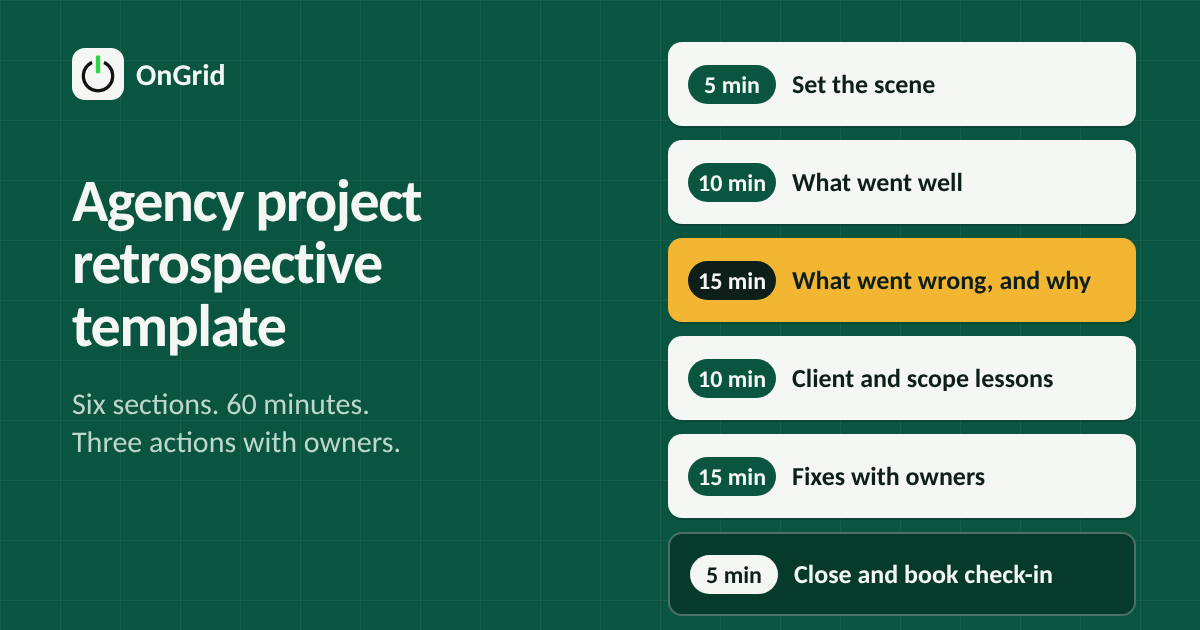
Use six sections with fixed time limits. They add up to 60 minutes.
Time | Section | What to cover |
|---|---|---|
5 min | Set the scene | State the goal, share the numbers, and agree the ground rules: facts first, no blame |
10 min | What went well | Three things to repeat on the next project |
15 min | What went wrong, and why | Pick the top two or three problems and ask “why” until you reach a root cause |
10 min | Client and scope lessons | Where scope changed, approvals stalled or expectations differed |
15 min | Fixes | Choose up to three actions, each with an owner and a due date |
5 min | Close | Read back the actions and book the check-in |
The “why” step is the one teams skip. “The design was late” is a symptom. “Feedback arrived from three people on different days” is a cause you can fix. Our client kickoff meeting agenda helps you prevent that one at the start of the next project.
How do you keep a retrospective blameless?
Talk about the process, not the person. Instead of “Rahul missed the deadline,” ask “what made the deadline impossible to hit?” Let the most junior person speak first, so seniors do not set the tone. If someone starts blaming, bring the discussion back to the question “what would we change in the process?”
How do you turn findings into actions?
Limit yourself to three actions. A list of ten fixes means none will happen. For each action, write four things: what will change, who owns it, when it is due, and how you will know it worked. Then review the actions in your next weekly review meeting, so they do not disappear after the meeting ends.
Copy-and-paste agency project retrospective template
PROJECT RETROSPECTIVE: [Client / Project], [Date]
Attendees:

Numbers
Planned hours / actual hours:
Deadlines hit / missed:
Revision rounds quoted / used:
Change requests (approved / absorbed):

1. What went well (repeat these):
-

2. What went wrong, and the root cause:
Problem:
Why (ask 3 times):

3. Client and scope lessons:
-

4. Actions (maximum 3)
Action / owner / due date / how we will know it worked:

5. Check-in date:
What mistakes should you avoid?
Skipping it when the project went well. Success has causes too, and you want to repeat them.
Running it with no data. Without numbers, the loudest opinion wins.
Inviting the client. Keep it internal, and share a short summary only if useful.
Leaving without owners. An action with no name will not happen.
Never checking back. Review the last retrospective’s actions at the start of the next one.
Frequently asked questions
How long should a project retrospective be?
Sixty minutes works for most agency projects. Small projects can take 30 minutes, and large or problem projects may need 90.
Who should attend an agency project retrospective?
Everyone who worked on the project: the account manager, project lead, designers, developers and writers. Leave out people who were not involved.
What is the difference between a retrospective and a post-mortem?
A post-mortem usually follows a failure and looks for what went wrong. A retrospective looks at the whole project, successes included, and focuses on what to change next time.
How often should an agency run retrospectives?
After every significant project, and quarterly for retainers. Skip tiny jobs, or batch several into one session.
Should you share the retrospective with the client?
Not the full notes. Share a short summary of what you will do differently if it builds trust, such as a new approval step or a clearer scope document.