Daily Standup Template for Agencies: A 10-Minute Format That Works
By Ongrid · 23 October 2026 · 3 min read
In short
- A good agency standup takes 10 minutes or less and answers three things: what is due today, what is blocked, and what changed with a client. Use the template below, keep it to one agreed time, and move written updates out of the meeting so the live time is only for blockers.
Everyone knows the standup that starts at 10 minutes and ends at 40. Someone reads out their whole task list, someone else joins late, and by the end the only thing decided is that you need another meeting.
For agencies it is worse. You are juggling five clients, three deadlines and a festive-season rush, and a long standup eats the exact hours you are trying to protect. This post gives you a daily standup template built for agency work, plus a way to run it without it becoming a status meeting.
What is a daily standup in an agency?
A daily standup is a short, fixed-time check-in where the team shares what they are working on, what is blocking them and what needs a decision. In an agency, it also covers client deadlines and approvals waiting on someone. The goal is not reporting. It is spotting problems early enough to fix them the same day.
Why do agency standups usually fail?
Most fail for the same four reasons:
They become a status report. People list tasks that are already visible in the project tool.
They run too long. Once a meeting passes 15 minutes, people stop listening.
They ignore clients. The team discusses tasks but not what a client said yesterday.
Blockers get named but never owned. Someone says “waiting on feedback” and nobody follows up.
If your standup has any of these, the fix is a tighter format, not a better time slot.
How do you run a 10-minute standup?
Pick one fixed time. Choose a slot when everyone is online, such as 10:30 AM IST, and never move it.
Set a hard timer. Ten minutes total. If it runs over, the format is too loose.
Go by client, not by person. For a larger team, walk through each client account in turn so nothing gets missed.
Park long discussions. If a topic needs more than a minute, note it and take it offline with only the people involved.
Name an owner for every blocker. A blocker with no name next to it is just a complaint.
Write it down. Post the blockers and decisions where the whole team can see them afterwards.
Should your standup be live or written?
For teams of up to 15 people, a short live standup works well. For teams with remote members, mixed time zones or people on client calls in the morning, a written update often works better. Everyone posts the same five prompts before a set time, and the team lead only calls a live huddle if something is blocked.
A mix is usually best: written updates every day, a live check-in two or three days a week. In OnGrid, the Daily Pulse can hold the written update so the team doesn’t have to hunt through chat for it. See how it connects to your workload view to spot who is stretched before the day starts.
Copy-and-paste standup template
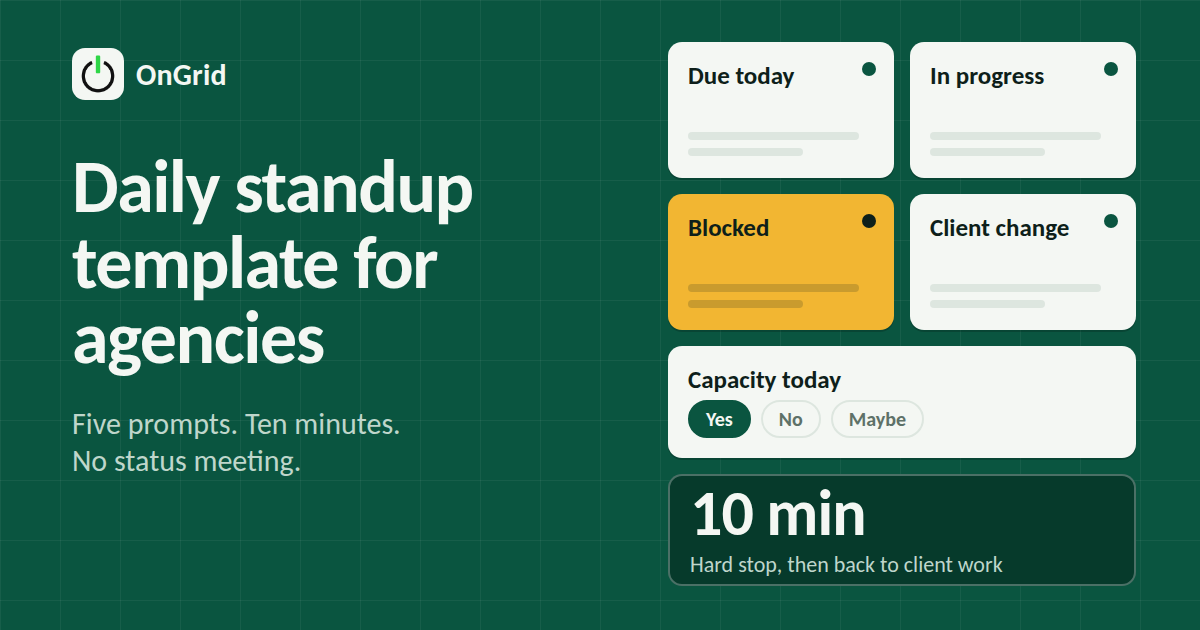
DAILY STANDUP: [Date]
Name:

1. Due today:
2. In progress:
3. Blocked (and who can help):
4. Client change or new request:
5. Capacity today: Yes / No / Maybe
Paste it into your team chat, a shared doc or your project tool, and ask everyone to fill it in before the standup time.
Common mistakes to avoid
Inviting everyone to everything. Only people working on active deliverables need to be there.
Using it to assign new work. Keep assignment in your task tool so the standup stays short.
Skipping it when things are calm. The days you skip are the days a blocker slips through.
Letting the lead talk the most. The lead’s job is to remove blockers, not to speak first.
Frequently asked questions
How long should an agency daily standup be?
Ten minutes is a good target, and fifteen is the maximum. If you regularly go over, reduce the prompts or move updates to writing.
How often should an agency run a standup?
Daily is standard, but small teams can run it three times a week with written updates on the other days.
What is the difference between a standup and a status meeting?
A standup focuses on today’s priorities and blockers. A status meeting reviews overall progress on projects, usually weekly, and involves more people and more detail.
Can we run a standup without a meeting?
Yes. A written standup works if everyone answers the same prompts by a set time and someone reviews the blockers.
Who should lead the standup?
Rotate the role weekly between team leads. It keeps the meeting short and prevents it becoming one person’s report.