Agency Capacity Planning: A Simple 5-Step Method for Small Agencies (With Template)
By Ongridwork · 27 November 2026 · 6 min read
In short
- Agency capacity planning compares the billable hours your team can actually deliver with the work you have committed. Calculate each person's capacity (working days × 8 hours × billable share × a safety ceiling of about 80 percent), compare it by role for the next four weeks, and act early by moving work, using freelancers or shifting deadlines before you hire.
Most agencies find out they are over capacity the hard way: a designer quietly works weekends, two deadlines collide, and the client hears about it last. Agency capacity planning prevents that by showing, weeks ahead, whether the work you have promised fits the hours your team can deliver. This guide explains agency capacity planning in five steps, with a worked example for a small team, a plan for Indian holidays and festive peaks, and a spreadsheet template you can copy.
What is agency capacity planning?
Agency capacity planning is the process of comparing the billable hours your team can realistically deliver with the work already committed and the work you expect to win, so you can add, move or decline work before deadlines slip. It is not headcount multiplied by 40 hours. Real capacity is smaller, because meetings, admin, selling, training, leave and holidays all take time away from client work.
How is capacity planning different from workload management?
Workload management balances who is doing what right now. Capacity planning looks further ahead, usually four to twelve weeks, and includes leave, public holidays, the pipeline and hiring. You need both: capacity planning tells you whether the next month fits, and workload management keeps this week fair. Our guide to workload management covers the day-to-day side, and your weekly review meeting is the natural place to check both.
How do you calculate agency capacity?
Use this formula for each person, then add them up by role:
Committable hours = working days × paid hours per day × billable share × planning ceiling
Agiled's guide describes a similar formula, people × weekly hours × billable percentage × weeks, minus time off, and recommends planning to roughly 80 to 85 percent of capacity so the buffer absorbs the unexpected. Follow these five steps. agiledagiled
List people by role. Plan by role, not headcount. Roadbase's guide notes that aggregate team utilization hides bottlenecks, so you should review capacity by role and not only in total. roadbase
Count real working days in the window, after public holidays and planned leave.
Apply a billable share. AgencyPro suggests targeting 65 to 80 percent utilization, with above 85 percent signalling burnout risk and below 60 percent signalling profitability problems. Use a lower share for senior people and account managers, who spend time on selling and strategy. agencypro
Apply a planning ceiling of about 80 percent, so there is room for revisions and surprises.
Compare with committed hours from signed projects and retainers, role by role.
For an 8-hour day, a 75 percent billable share and an 80 percent ceiling, each person can commit 4.8 hours per working day. Adjust the percentages to your own data over time, and see our guide to agency KPIs for how to measure utilization.
What does a capacity plan look like? A worked example
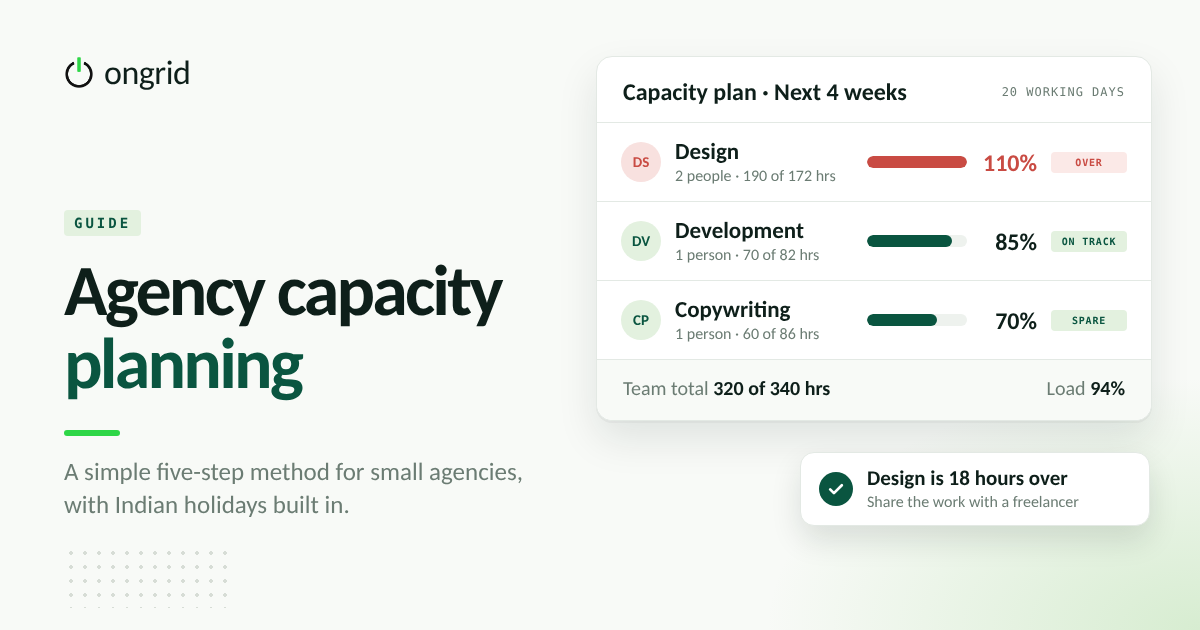
Take a four-person delivery team planning the next four weeks (20 working days). Two public holidays fall in the window, so each person has 18 working days, and the developer has one more planned leave day, so 17.
Role | People | Working days each | Committable hours | Committed hours |
|---|---|---|---|---|
Design | 2 | 18 | 172 | 190 |
Development | 1 | 17 | 82 | 70 |
Copywriting | 1 | 18 | 86 | 60 |
Total | 4 | 340 | 320 |
The numbers: design is 2 × 18 × 4.8 = 172 hours (rounded), development is 17 × 4.8 ≈ 82, copywriting is 18 × 4.8 ≈ 86.
At team level, 94 percent looks tight but manageable. By role, design is 18 hours over its limit while copywriting has 26 hours spare. This is the problem a single utilization number hides, and it is the main reason to plan by role.
What should you do when you are over capacity?
Decide early, using these options in order:
Move the date. Ask whether a deadline can shift by a week without harming the client.
Share the work. Use a freelancer from a bench of trusted people for the 18 extra design hours.
Swap scope. Trade something out: "We can add this if the pricing page moves to phase two."
Decline or defer new work. Say no, or offer a later start, for any new design request.
Check for hidden growth. If extra hours came from unpriced requests, tighten your scope creep process.
Do not default to overtime. It hides the problem for a month and then costs you the person.
How do you plan for Indian holidays, festivals and leave?
This is where most capacity guides fall short, because they assume UK bank holidays or US paid time off. For an Indian agency:
Use your state's holiday list for where your team sits, and mark public holidays and any optional or restricted holidays people are likely to take.
Update festival dates every year. Many festivals follow the lunar calendar, so the dates move, and some are regional.
Add long weekends. Teams often take extra days around holidays, so check the leave calendar before you commit.
Expect festive peaks and lulls. Many agencies see a rush of campaign work before major festivals and a slow patch afterwards, so reserve capacity six to eight weeks ahead.
Check your working week. Some teams work five days, others five and a half or six, and the formula should use the real number.
Keep one shared leave calendar so the plan uses real availability. If you manage it in OnGrid, attendance and leave management shows who is off before you assign work.
When should a small agency hire?
Set a trigger before you are overloaded, because sources disagree on the number. Roadbase's guide suggests opening a hiring conversation when average utilization exceeds 75 percent for six consecutive weeks, while AgencyPro suggests hiring when you sustain 80 percent or more for eight weeks or longer and subcontracting for spikes. A reasonable approach for a small agency is to pick your own rule, for example "committed load above 85 percent of committable hours for six weeks in a row", and write it down. roadbaseagencypro
Remember that a signed offer does not add capacity straight away. New hires take weeks to become fully productive, so plan around when a hire becomes useful capacity, not when they sign. operating
Which capacity planning strategy suits a small agency?
There are three standard strategies. Lead means hiring ahead of confirmed demand, lag means adding capacity only after demand is confirmed, and match means flexing capacity in near real time with a freelancer bench. Most small agencies do best with a match approach: a small core team, a bench of two or three reliable freelancers for design, writing and development, and a clear process for briefing them quickly. roadbase
How often should you update the capacity plan?
Check it weekly and plan two to four weeks ahead in detail, with a looser twelve-week view for large projects. FunctionFox suggests listing client and internal projects scheduled for the next four to twelve weeks. A 15-minute capacity check in your weekly review is enough. Once a month, replace your billable share with the real figure from the past quarter. functionfox
Do you need capacity planning software?
Not at first. A spreadsheet like the template below works well for a small team. Consider a tool when you want leave, projects and workload visible in one place, or when the sheet takes longer to update than the decisions are worth. OnGrid's workload heatmap and leave calendar show who is stretched and who is off, and the template below still works alongside it for forward planning. For the wider tool choice, see our comparison of project management software for agencies in India.
Copy-and-paste capacity planning template
CAPACITY PLAN: [Start date] to [End date] (weeks)

SETTINGS
Paid hours per day: 8     Billable share: 75%     Planning ceiling: 80%
Committable hours per working day = 8 x 0.75 x 0.80 = 4.8
Public holidays in window (state, festivals): [dates]

BY ROLE
Role | People | Working days each (after holidays and leave) |
Committable hours | Committed hours | Load (committed / committable)

Design:
Development:
Copywriting:
Account management:

OVER CAPACITY? (load above 100%)
Role / hours over / option chosen (move, share, swap, defer) / owner / date:

UPCOMING: probable work (pipeline x close rate):
Hiring trigger: load above [85]% for [6] weeks in a row
Freelancer bench (name / skill / availability):

Next review date:
What mistakes should you avoid?
Using 40 hours per person. Real capacity is much lower once non-billable time is removed.
Planning only in total. A balanced average can hide an overloaded role.
Forgetting leave and holidays. Check the calendar before you commit.
Planning to 100 percent. Revisions and surprises always arrive.
Planning once. A plan that is not updated weekly is out of date within a month.
Frequently asked questions
How do you calculate agency capacity?
Multiply working days by paid hours per day, then by your billable share and a planning ceiling of about 80 percent, for each person. Add the results by role and compare with committed hours.
How far ahead should an agency plan capacity?
Plan two to four weeks ahead in detail and up to twelve weeks at a higher level, especially for large projects and festive peaks.
What utilization should an agency plan for?
Many sources suggest roughly 65 to 80 percent overall, lower for senior staff, with sustained levels above about 85 percent raising burnout risk.
What are the three types of capacity planning?
Lead (hire ahead of confirmed demand), lag (add capacity after demand is confirmed) and match (flex capacity with a freelancer bench).
Do I need software for agency capacity planning?
No. A spreadsheet is enough for a small team. Software helps once leave, projects and workload need to be visible in one place.