Client Reporting Template: A One-Page Report Clients Read
By OnGrid · 26 October 2026 · 8 min read
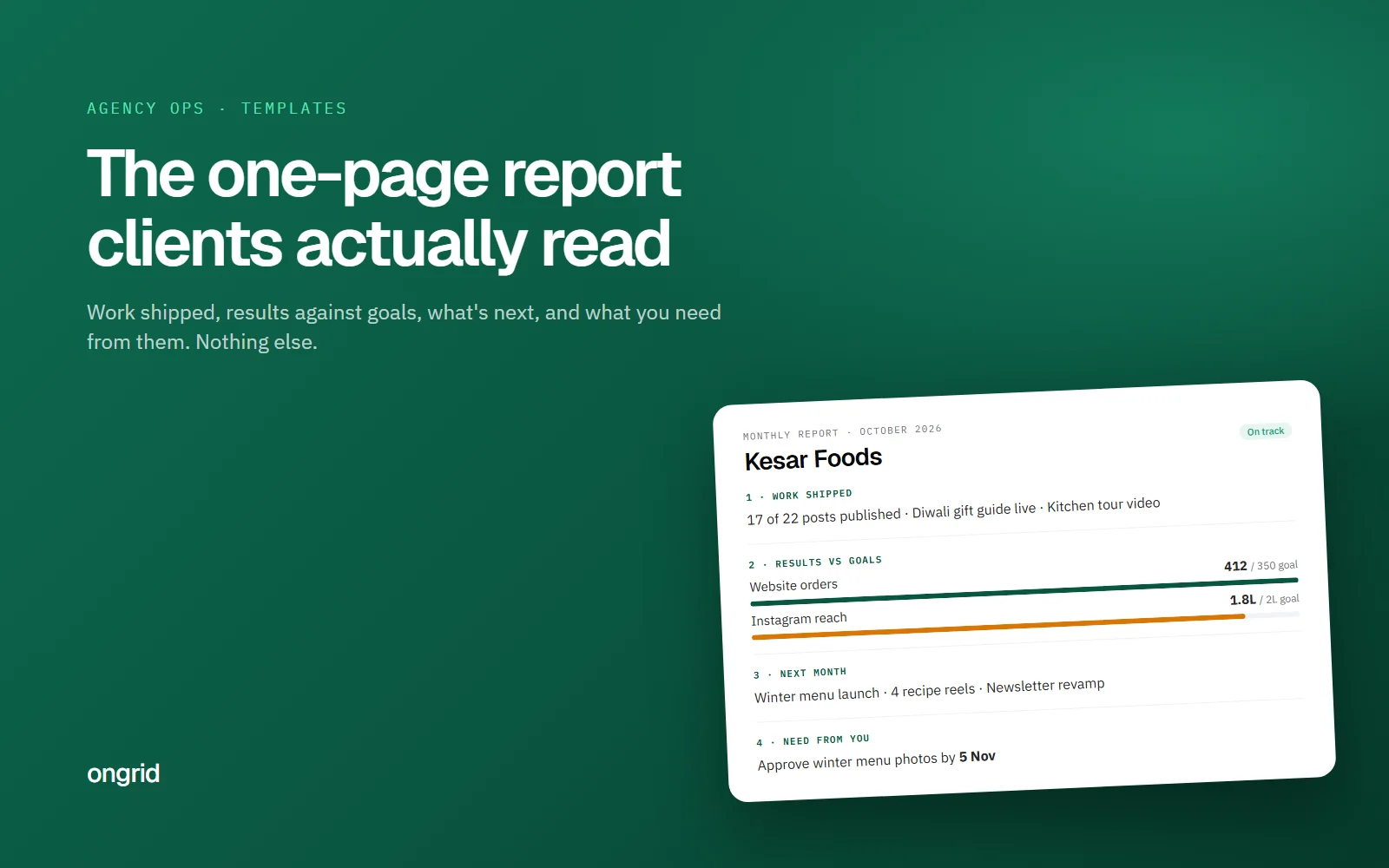
In short
- A good client reporting template fits on one page and answers four questions in order: what we shipped, how results compare to the agreed goals, what happens next, and what we need from the client. Put the biggest result, biggest problem and one decision in a three-line summary at the top.
Most client reports are written for the agency, not the client. Ten pages of screenshots, every metric the dashboard can export, and the one thing the client wanted to know is on page seven. A good client reporting template fixes that by forcing you to answer four questions on a single page: what did we ship, did it work, what happens next, and what do we need from you.
This guide gives you that template, a filled-in example for a real-looking retainer, and the rules we use to keep it short. It works for marketing, creative and development agencies, weekly or monthly.
What is a client report actually for?
A client report has one job: help the person paying you decide to keep paying you. That sounds blunt, but it changes what goes in. The client is not checking whether you were busy. They want to know whether the money is turning into results, and whether anything needs their attention.
So a report is not a log of activity. "We posted 22 times" is activity. "Instagram sent 1,050 people to your site, up from 780 last month" is a result. Activity belongs in the report only as proof behind a result, or when the work itself is the deliverable, like a website build where shipped pages are the point.
The second job is a paper trail. When a client asks in month five why the campaign changed direction, you point to the month-three report where they agreed to it. Clear results every month also make the renewal and pricing conversation easier, which is why our agency retainer pricing guide ties report metrics to the retainer itself.
What should a client reporting template include?
Five sections, in this order. Order matters, because most clients read the top and skim the rest.
The summary (3 lines). The single most important result, the single biggest problem, and the one decision you need. If the client reads nothing else, they should still know where things stand.
Work shipped. What was delivered this period, as a short list with links. Group it by goal, not by team member.
Results against goals. Only the 3 to 5 numbers you agreed on at the start, each shown against its target and last period. No new metrics without a reason.
What happens next. The plan for the coming period, with dates. This is where you show you are ahead of the work.
What we need from you. Approvals, assets, access, feedback, each with a date. This is the section clients skip most, so keep it to three items at most and put the most urgent one in the summary too.
If the goals and targets were never agreed, fix that first. The reporting conversation belongs in onboarding, which is why we put "agree the report metrics" on our client onboarding checklist. Reporting against goals you invented yourself is guesswork with formatting.
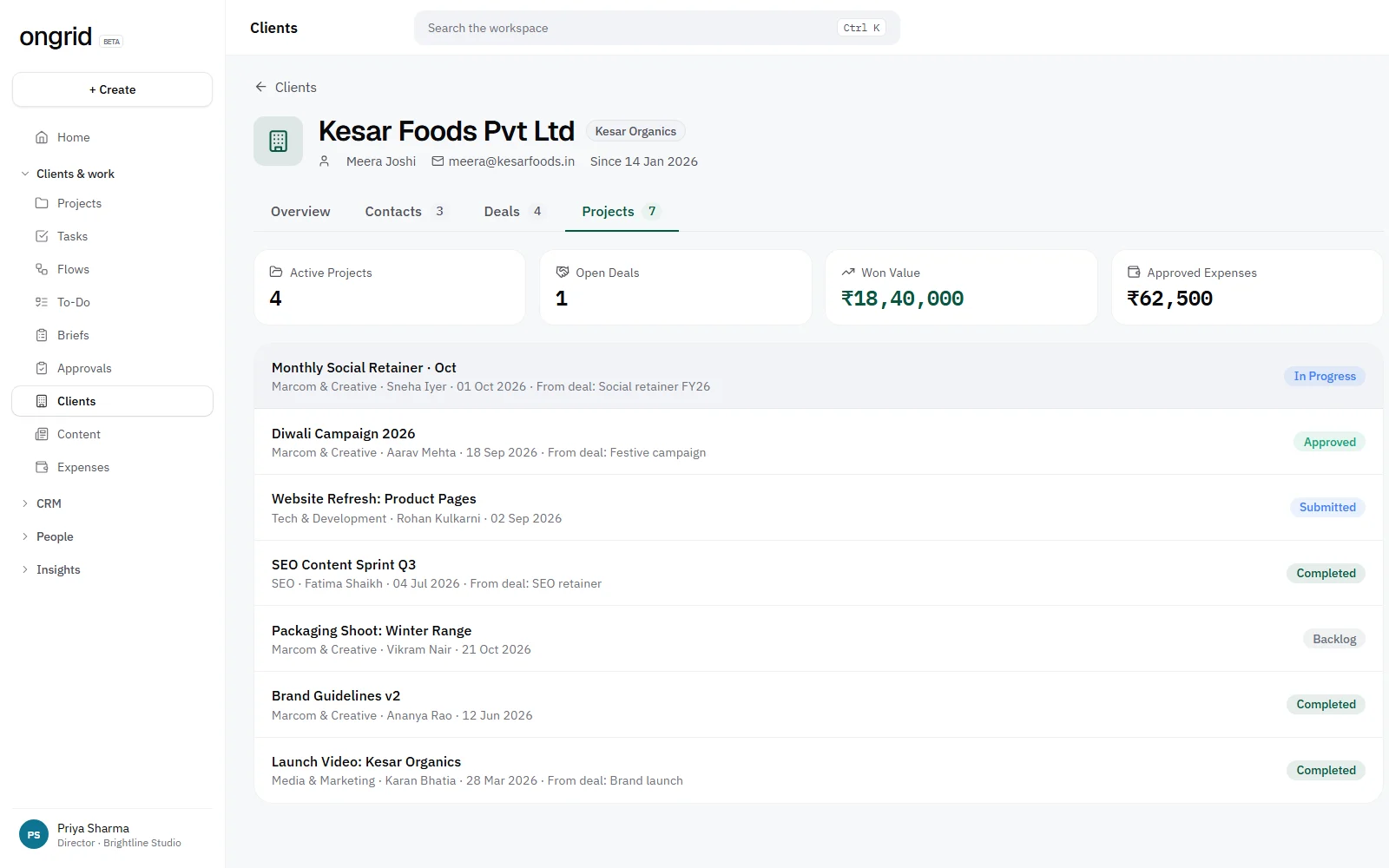
The client reporting template (copy this)
Here is the template filled in for an example: a social media retainer for a bakery chain with three outlets in Pune, billed at ₹85,000 a month, with ₹15,000 a month of ad spend on top. Swap in your own client and numbers.
October report: Sweet Crumb Bakery, social media
Summary
Leads from Instagram hit 46 against a target of 40, the best month since we started.
Website visits from Instagram were 1,050, short of the 1,200 target because two reels were delayed.
Decision needed: approve the Diwali hamper campaign by 3 November so it can go live on 6 November.
Work shipped
Goal: more walk-ins. 14 feed posts and 6 reels featuring the new Baner outlet (links in the content calendar).
Goal: more online orders. 2 carousel ads for the cake pre-order page, A/B tested on headline.
Goal: brand. Festive menu photoshoot, 40 edited images delivered to the shared drive.
Results against goals
Instagram leads (DMs and form fills): 46. Target 40. Last month 33.
Website visits from Instagram: 1,050. Target 1,200. Last month 780.
Ad leads: 30 from ₹15,000 spend, so ₹500 a lead. Target ₹600 or less.
Posts published vs planned: 20 of 22. Two reels moved to November (reason below).
What happens next
6 to 12 November: Diwali hamper campaign, 4 reels and 1 ad set (needs approval).
From 15 November: shift ad budget to the pre-order headline that won the test.
By 20 November: a short report on which outlet gets the most Instagram enquiries.
What we need from you
Approve the Diwali hamper concept by 3 November.
Hamper prices and stock limits by 3 November.
Access to the Google Business Profile for the Baner outlet.
That fits on one page. Notice what is missing: reach, impressions, follower count, best time to post. Those are fine for your internal review. The client did not hire you for impressions, so they are not in the client report unless a goal depends on them.
How do you keep a client report to one page?
People do not read reports, they scan them. Nielsen Norman Group found that 79% of test users always scanned a new page and only 16% read word by word. Your client is the same person on a busy Monday. Write for the scan.
One number per line. Result, target, last period. Never a paragraph of numbers.
Lead with the verdict. "Leads beat target" before the chart, not after it.
Short, active sentences. "We moved two reels to November" beats "Two reels were moved due to scheduling considerations." The US government's plain language guidance on writing for understanding makes the same case for active voice and short sections, and it holds for client reports.
Put the dashboard in a link. Charts and raw exports go in an appendix or a live dashboard. The report itself is the reading layer on top.
Cut anything you would not defend. If a client asked "why is this here?" and you had no good answer, delete it.
A rule that helps: if the report takes more than 5 minutes to read, it is two reports pretending to be one.
How often should you send client reports?
Match the cadence to how fast the work changes and how much the client is paying. Too often and nobody reads them. Too rarely and problems surface late.
Monthly: most retainers (social, SEO, content, ongoing design). Send within the first 3 working days of the month.
Fortnightly: development and website projects, timed to the end of each sprint, with a demo link.
Weekly: launches, paid campaigns with large budgets, or any account that is at risk. Keep these to the summary and next steps only.
Quarterly review on top: for retainers above roughly ₹1 lakh a month, a 30-minute call that looks at the trend across three reports and resets goals.
Weekly internal updates are a different thing. The team-facing version, with owners, blockers and dates, is a project status report. Do not send that to clients as-is. It is written for people who know the work, and it reads like excuses to people who do not.
Who should write the client report?
One person owns it: the account manager or whoever holds the client relationship. Specialists feed in their numbers, but the owner writes the summary and the "what we need" section, because those need judgement about the client, not just data.
A rhythm that works for a 10 to 30 person agency:
Day 1 of the month: specialists drop their numbers and shipped links into the report draft.
Day 2: the account manager writes the summary, checks every number against its target, and adds the asks.
Day 3: a lead or founder reads it for tone, especially if a result was missed. Then it goes out.
If day 1 turns into chasing people on WhatsApp for their numbers, the problem is upstream. Work that is tracked as it happens does not need to be reconstructed at month end, which is the whole argument in our guide to stopping the chase for task updates.
[TEAM NOTE: Add how long our own monthly client reports took before and after we moved to this one-page format, with a real example of a client who started replying to the "what we need from you" section.]
What do you put in the report when results are bad?
Put the bad result in the summary. Clients forgive a missed target. They do not forgive finding it themselves on page four.
Use the same four beats every time: what happened, why, what you are changing, and what you need. In the example above, website visits missed target because two reels slipped. The honest version is: "Visits were 1,050 against 1,200. Two reels slipped because product shots arrived on the 24th. We have moved the shoot to the first week of each month. Please confirm the November shoot date."
A missed number with a reason and a fix reads as competence. A missed number with no comment reads as either hiding or not noticing.
Do not swap to a metric that went up instead. If the client agreed on visits, report visits. If the goal itself was wrong, propose a new one in the "what we need" section.
[TEAM NOTE: Add a real (anonymised) case where we reported a missed target early and it strengthened the client relationship, or one where hiding it backfired.]
Where should the numbers in a client report come from?
Two places, and they should not be the same tool.
Results come from the channel data: analytics, ad platforms, the CRM. If you want a live dashboard the client can open any time, Google's free Data Studio turns those sources into shareable reports. Link it from your report rather than pasting screenshots of it.
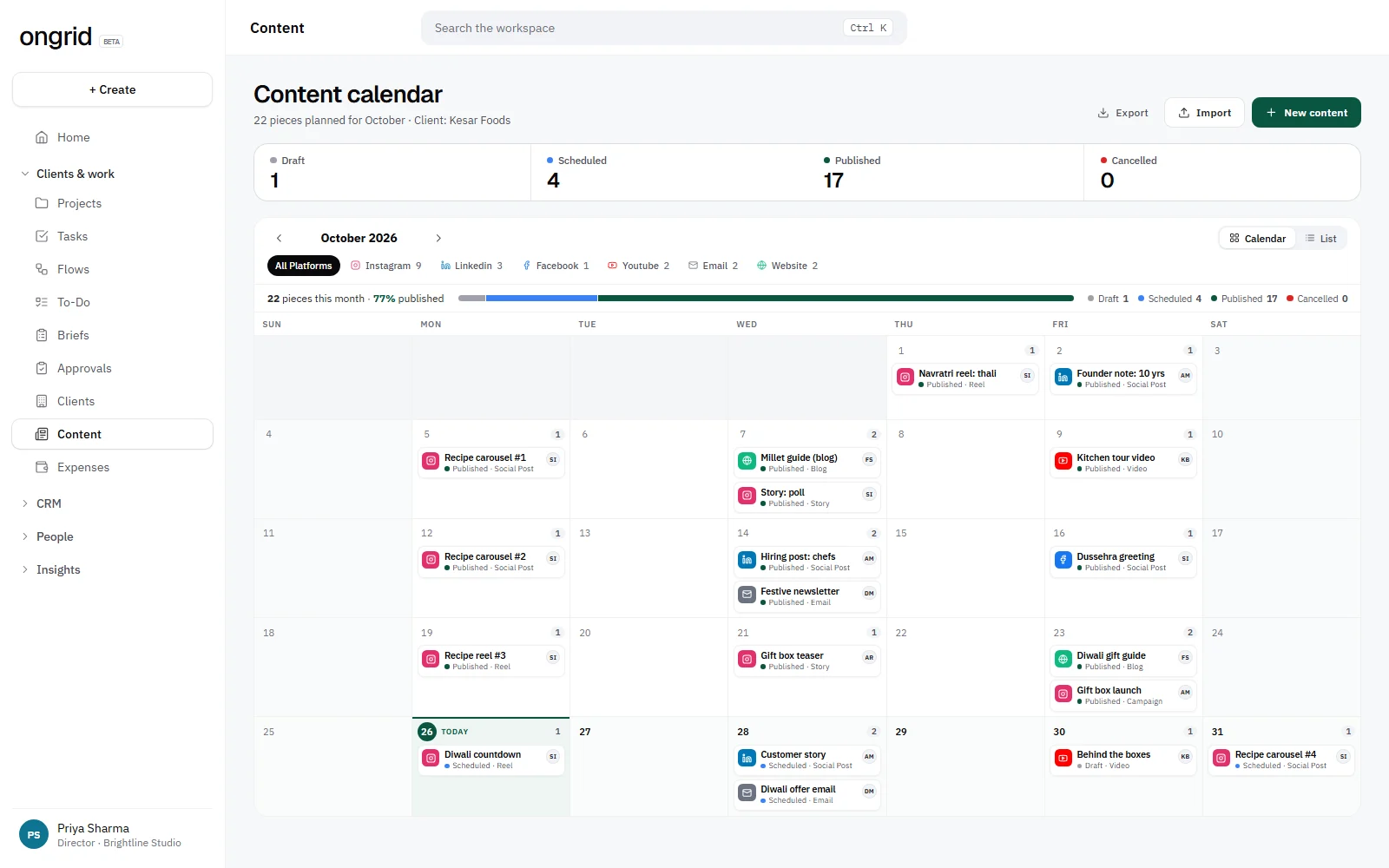
Work shipped comes from where the work is managed. In OnGrid, each client page lists the projects you are delivering for them, each project shows its tasks with status and due dates, and the content calendar shows what was scheduled and what actually went out. That makes the shipped list a filter, not a memory exercise. If you are running several accounts at once, the setup in managing multiple client projects keeps each client's work separate enough to report on cleanly.
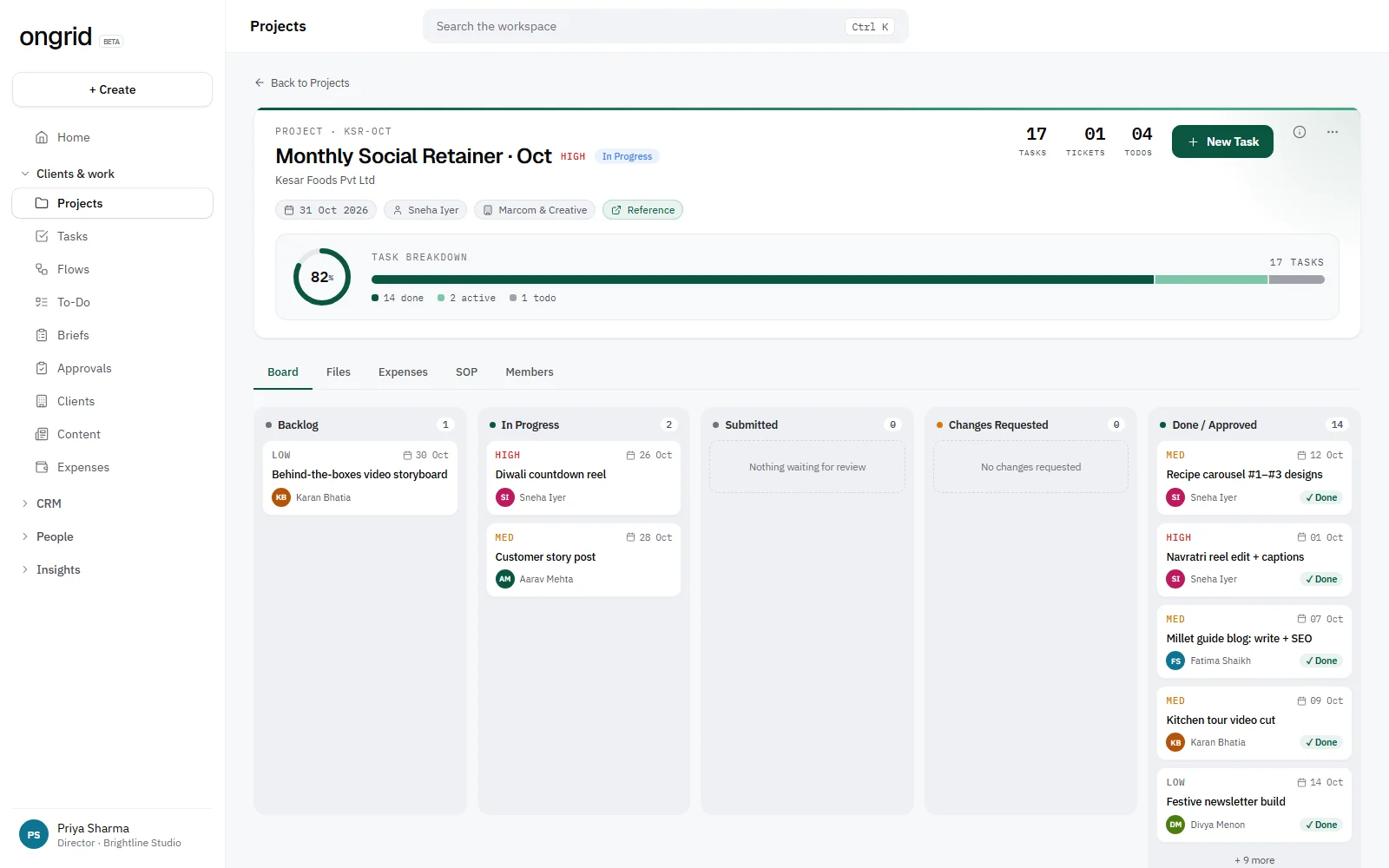
Two habits help. Log approvals where the work lives, so the report says "approved on 12 October" (see our client approval process). And plan content in one content calendar, so planned vs published counts come straight from it.
Copy the template above, fill it for one client this month, and time how long it takes. If the "work shipped" part takes the longest, that is a sign the work is not tracked where it happens. OnGrid keeps clients, projects, tasks and the content calendar in one workspace, so that section mostly writes itself. You can try it free with no credit card.
Frequently asked questions
What should be included in a client report?
A three-line summary, the work shipped, results against the goals you agreed at the start, the plan for next period, and what you need from the client. Keep results to the 3 to 5 metrics the client actually cares about, each shown against its target and last period.
How long should a client report be?
One page for the report itself, readable in under 5 minutes. Charts, raw exports and detailed breakdowns go in an appendix or a linked live dashboard, so the client gets the verdict first and the detail only if they want it.
How often should agencies send client reports?
Monthly suits most retainers, sent in the first three working days of the month. Development projects work well fortnightly at the end of each sprint, and launches or at-risk accounts may need a short weekly update. Larger retainers benefit from a quarterly review call on top.
What is the difference between a client report and a status report?
A status report is internal: owners, blockers and dates for people who know the work. A client report is written for the client and focuses on results, decisions and what you need from them. Sending an internal status report to a client usually reads as noise or excuses.
How do you report bad results to a client?
Put the missed result in the summary, not buried later. Say what happened, why, what you are changing, and what you need from the client. Do not switch to a different metric that went up; if the original goal was wrong, propose a new one in writing.