Agency Retainer Pricing: How to Price Monthly Retainers
By OnGrid · 26 October 2026 · 8 min read
In short
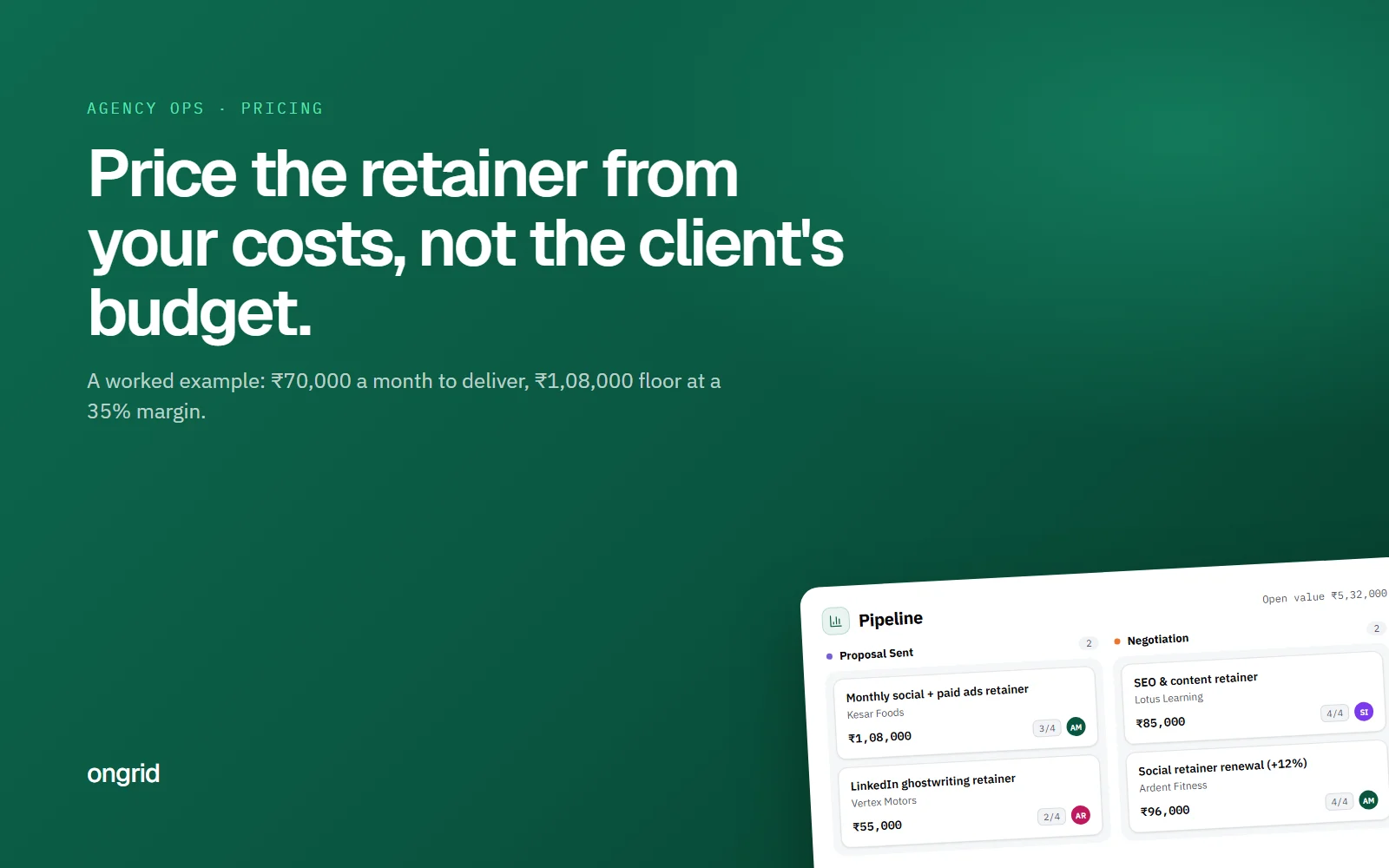
- Price a retainer from what it costs you to deliver: add up each person's loaded hourly cost for the hours the client needs, then divide by (1 − your target margin) to get your floor. Write the scope, revision limits and overage rules down before month one, and compare actual hours to the estimate every month.
Most agencies price their first retainer by asking what the client can afford, then quietly hoping the work fits. It rarely does. Six months later the account is busy, the team is stretched, and nobody can say whether the client is profitable.
Good agency retainer pricing starts from the other end: what the work costs you to deliver, what you need to keep, and what the client gets for a fixed monthly fee. This guide walks through the three common pricing models, a worked ₹ example for finding your floor, and the rules (scope, rollover, overage, price rises) that stop a good retainer turning into an unpaid one.
What are the three ways to price an agency retainer?
Almost every retainer you will see in India falls into one of three models. Most agencies end up mixing them, but it helps to know which one is doing the real work in your contract.
1. Hours-based retainers
The client buys a block of time, say 80 hours a month, at an agreed rate. It is easy to explain and easy to check. The problem is that it turns every conversation into a conversation about hours. Clients start asking why a banner took three hours, and your team starts padding timesheets.
Hours-based works best for open-ended work where the deliverables genuinely change month to month: ongoing consulting, development support, or a brand that sends whatever lands on the marketing head's desk.
2. Deliverables-based retainers
The client buys a defined output: 16 social posts, 4 reels, 2 blog articles and a monthly report. You price each unit internally from your hours, but the client only sees the list. This is the most common model for social media and content retainers, and the easiest to sell, because the client can picture exactly what arrives.
The risk is the edges. "One reel" can mean a 15-second cut from existing footage or a two-day shoot. If the scope document does not say which, you will find out the hard way.
3. Value-based retainers
You price against the outcome for the client rather than your cost: a share of the revenue a performance campaign drives, or a fee tied to leads delivered. Done well, it pays far better than either model above. Done badly, you carry the client's risk for things you do not control, like their sales team, pricing or stock levels.
Our view: start most new clients on deliverables-based pricing with a clear hours estimate behind it. Move to value-based only once you have six months of data showing what your work actually moves.
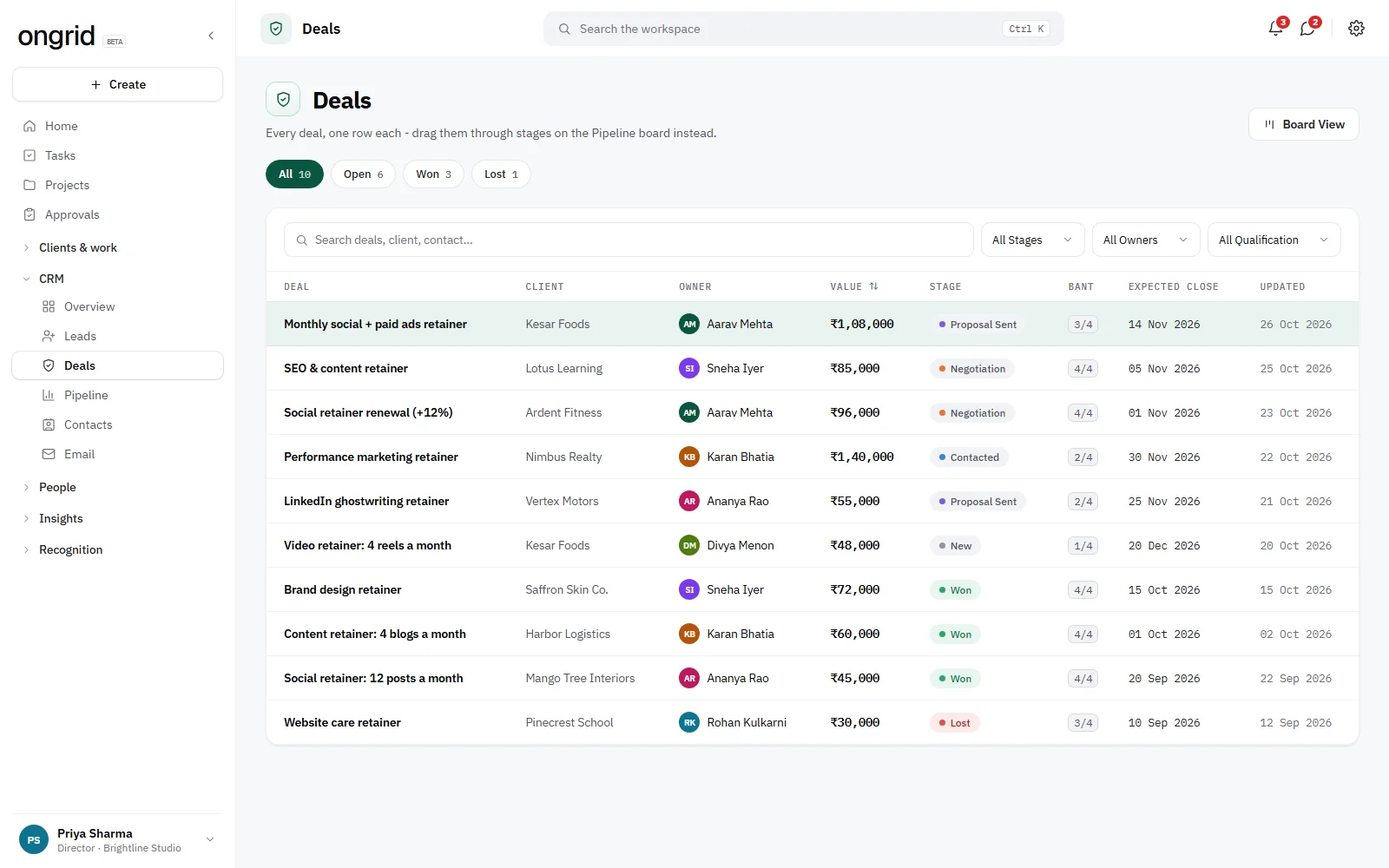
Whichever model you pick, put the retainer into your CRM as a deal with its real monthly value and an expected renewal date. If you are still choosing a tool, our guide to CRMs for agencies covers what to look for.
How do you work out the floor price for a retainer?
Your floor is the lowest monthly fee at which the account still makes the margin you need. Below it you are paying to keep the client. Here is the calculation with numbers from a typical small Indian agency. Swap in your own.
Step 1: Find each person's loaded hourly cost. Take monthly CTC, add overhead (rent, software, admin staff, laptops, the bench time between projects) and divide by billable hours. In this example we assume overhead adds 30% to CTC, and that people are billable about 70% of a 176-hour month, which is roughly 123 hours. These are assumptions, not industry figures, so check them against your own books.
Account manager: ₹70,000 CTC → ₹91,000 loaded → about ₹740 an hour
Designer: ₹50,000 CTC → ₹65,000 loaded → about ₹528 an hour
Copywriter: ₹45,000 CTC → ₹58,500 loaded → about ₹476 an hour
Performance marketer: ₹65,000 CTC → ₹84,500 loaded → about ₹687 an hour
Step 2: Estimate the hours this client needs each month. Use the scope, not hope. For a social plus paid-ads retainer:
Account manager, 20 hours (calls, approvals, reporting): ₹14,800
Designer, 45 hours: ₹23,760
Copywriter, 30 hours: ₹14,280
Performance marketer, 25 hours: ₹17,175
Total delivery cost: about ₹70,000 a month.
Step 3: Add your margin. If you want a 35% margin, divide cost by 0.65, not multiply by 1.35. ₹70,000 ÷ 0.65 is about ₹1,08,000. That is your floor. Multiplying by 1.35 would give ₹94,500, which is only a 26% margin. It is the most common mistake in agency pricing.
Step 4: Add GST on top. At 18%, the invoice comes to about ₹1,27,440. Quote the fee and the GST separately, so the client's finance team never thinks your price "went up" when the tax line appears.
[TEAM NOTE: Replace or sit beside this with one real (anonymised) OnGrid or client retainer: what it was first priced at, what the actual monthly hours turned out to be after three months, and what you changed. Real before/after numbers are the most useful thing in this post.]
If the client's budget is below your floor, do not discount the fee. Cut the scope until the hours fit: fewer posts, no reels, reporting every two months instead of every month.
Agency retainer pricing: what should the scope document say?
The scope is where retainers are won or lost. The fee only means something if both sides agree on what it buys. A one-page scope should cover:
Deliverables with a definition. Not "4 reels" but "4 reels, up to 30 seconds, edited from footage the client supplies".
Revision rounds. Two rounds per deliverable is common. A third round is billed or comes out of the hours bank.
Turnaround times. For example, 3 working days for a new design and 1 day for a revision.
What is not included. Shoots, influencer fees, ad spend, printing, translations. Write them down even if they feel obvious.
Approval rules. Who on the client side signs off, and what happens if feedback takes a week. Our post on building a client approval process has a template for this.
Reporting. What the monthly report contains and when it lands. A fixed client reporting template keeps this from eating the account manager's week.
Hand the signed scope to the delivery team on day one, not just the sales team. Our client onboarding checklist covers that handover.
What happens to unused hours and extra work?
Decide this before the first month, because the first disagreement will come sooner than you think.
Unused hours. A fair rule is that up to 20% of a month's hours can roll into the next month only, then they expire. Unlimited rollover sounds generous, but it builds a debt you will be asked to repay in a busy quarter, all at once.
Overage. When a month runs over, you have two clean options. Bill the extra hours at your normal rate, or treat anything outside scope as a change request with its own quote. What does not work is absorbing it "this once". Once becomes the new baseline in about three months.
If the client asks for it in writing, it gets quoted in writing. That one rule saves more retainers than any contract clause.
How do you stop scope creep inside a retainer?
Scope creep is the slow, often unapproved growth of what a project includes after it starts. Wikipedia's summary is a decent plain-language definition. In retainers it rarely arrives as a big request. It arrives as "a quick resize", "one more caption option", "can you also post on LinkedIn".
Three habits catch it early:
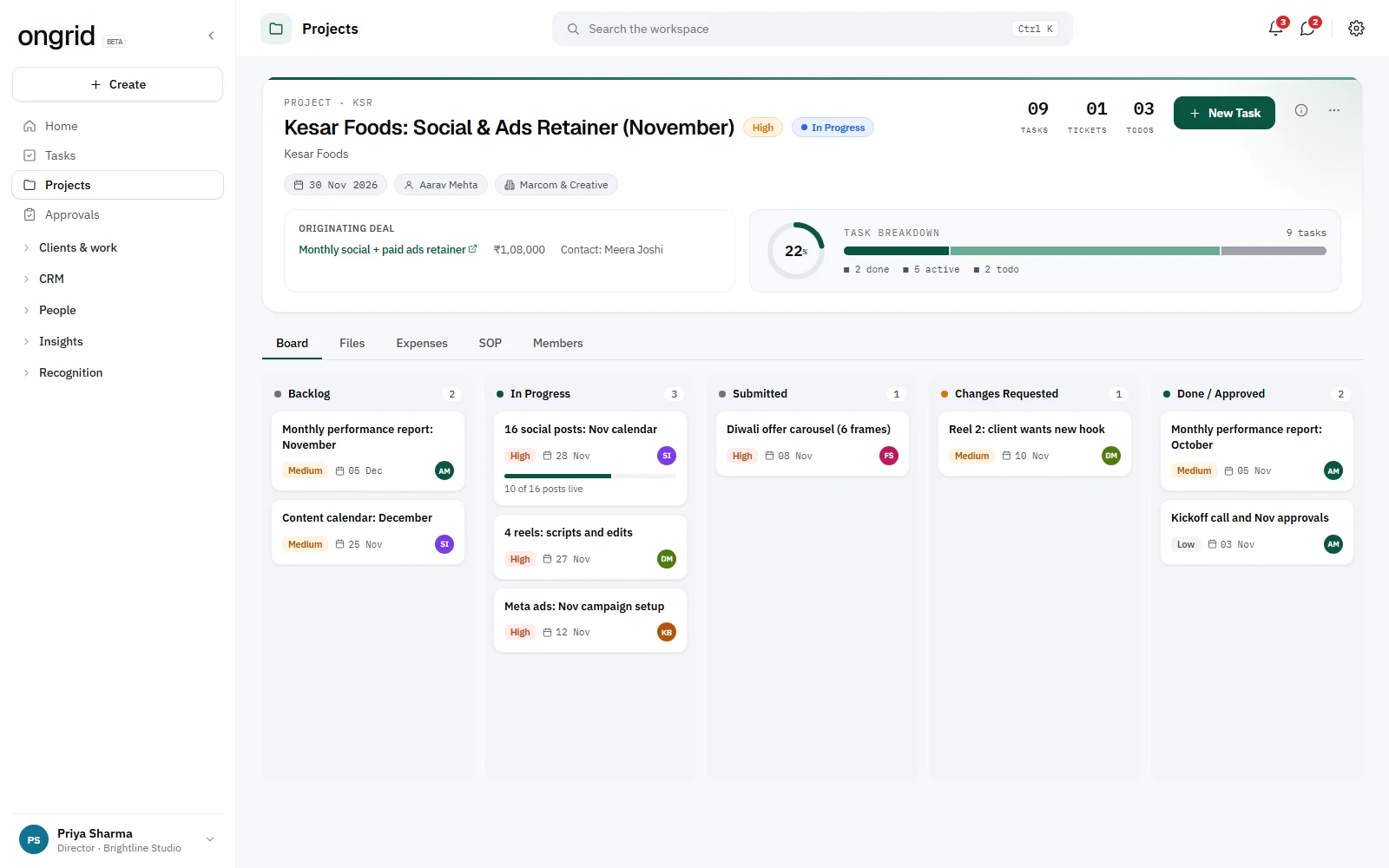
Track every request as a task. If it is not on the board it is invisible, and invisible work cannot be priced. Our guide to managing multiple client projects shows a simple board layout.
Compare actual hours to the estimate every month. Two months over by 15% or more means the scope has changed, whether anyone said so or not.
Watch who is carrying the account. Creep usually lands on one designer or one writer first. Their workload tells you before the client report does.
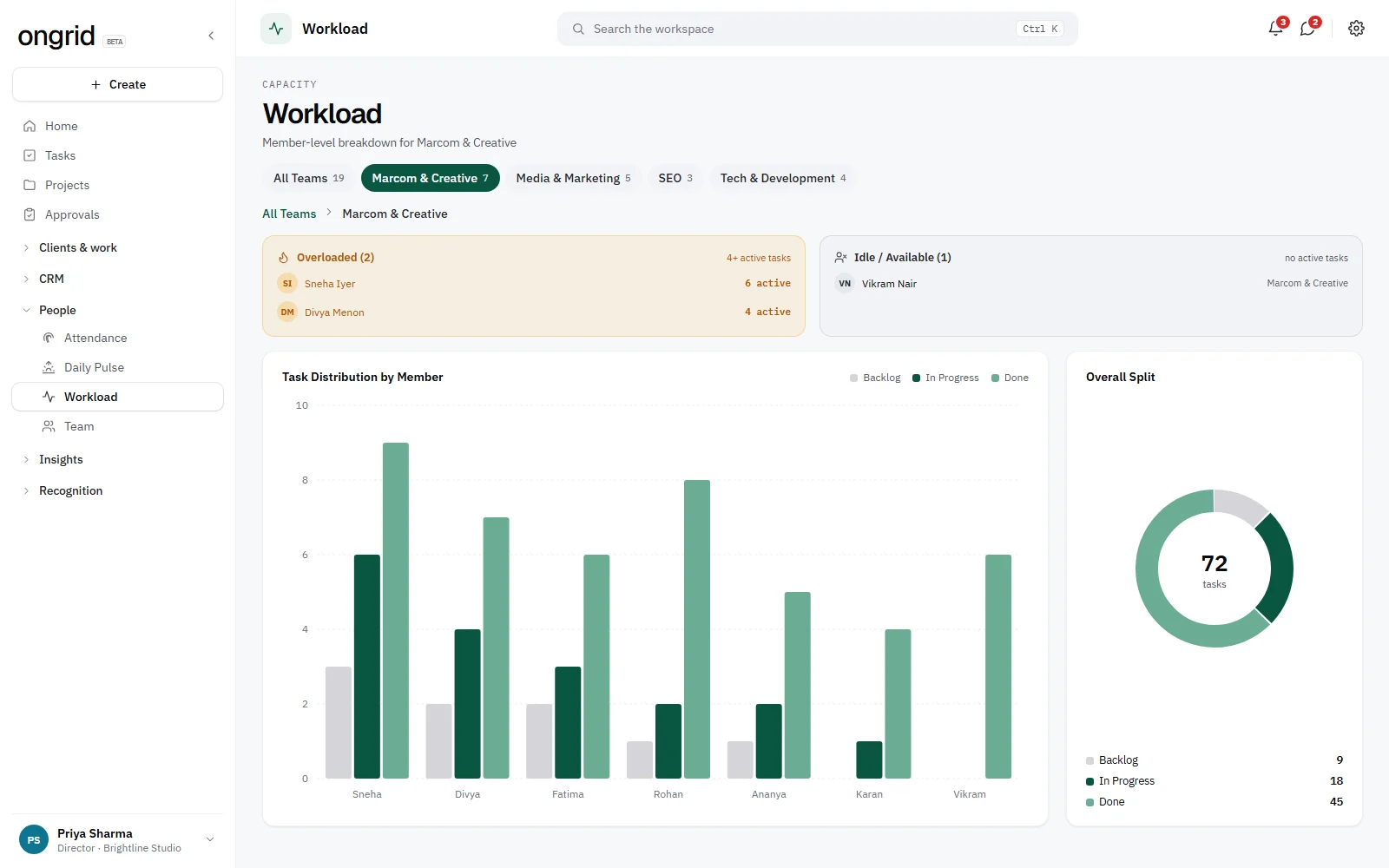
OnGrid's workload screen flags anyone with four or more active tasks, which is often the first place a growing retainer shows up. More on balancing this in our workload management guide.
When should you raise retainer prices?
Most agencies wait too long, then raise by too much at once. A steadier approach:
Once a year, on a known date. Many Indian agencies tie it to April, when salary revisions land and their own costs go up. Put the review date in the contract so it is never a surprise.
When the hours have grown. If actual hours have been above the estimate for three months, you have a case for re-pricing or re-scoping. Show the data.
When you add a new service. A new channel or deliverable is a new line on the scope, with its own price.
Give at least 30 to 60 days' notice. Frame it around the scope ("here is what the account now includes"), not around your costs.
[TEAM NOTE: Add a short real story of a price rise conversation: how much you raised it, how you explained it, and whether the client stayed. Include what you would say differently next time.]
Price conversations go better when the client already sees regular progress. A short project status report every week or two does a lot of that work for you. So do the follow-ups covered in our sales follow up guide when a renewal is due.
Do you charge GST on an agency retainer?
In most cases, yes. Advertising and marketing services in India are generally taxed at the standard 18% GST rate, and registration is required once your services turnover crosses the threshold, ₹20 lakh for most states. Razorpay's guide to GST on advertising services sets out the rates, SAC codes and exceptions. Treat this as a starting point and confirm the treatment for your services with your CA, especially for export clients or mixed contracts.
Putting it together
Pick the model that matches the work, price from your real costs with the margin worked out properly, write the scope down in detail, and decide the rollover and overage rules before you need them. Then check actual hours against the estimate every month.
If you want the deals, projects and team workload for each retainer in one place, you can try OnGrid free. It is built for agencies running several client accounts at once.
Frequently asked questions
How much should an agency charge for a monthly retainer?
There is no single market rate, because it depends on your team's costs and the scope. Work it out from the bottom up: estimate the hours each person spends on the client, multiply by their loaded hourly cost, then divide by (1 − your target margin). That number is your floor, and you should not go below it.
Is it better to price a retainer by hours or by deliverables?
Deliverables-based pricing is easier to sell and suits content and social media work, where the output is predictable. Hours-based pricing suits open-ended work like consulting or development support. Many agencies sell deliverables but keep an internal hours estimate behind each one.
What should happen to unused retainer hours?
Agree a rule in the contract before the first month. A common approach is to let a small share, such as up to 20% of the month's hours, roll into the next month only, after which it expires. Unlimited rollover builds up a large block of owed work that clients tend to call in during your busiest period.
How do I handle work outside the retainer scope?
Treat it as a change request with its own written quote, or bill the extra hours at your agreed rate. Log every request as a task so you can see the extra work. Absorbing out-of-scope work "just this once" usually becomes the new normal within a few months.
How often should an agency raise retainer prices?
Review prices once a year on a date written into the contract. Many Indian agencies use April, when their own salary costs rise. Also re-price when actual hours have been above the estimate for about three months in a row, and give the client 30 to 60 days' notice.