Workload Management: How to Balance Your Team's Work Before Someone Burns Out
By Gaurav Sharma · 15 October 2026 · 6 min read
In short
- Good workload management starts with seeing work in progress per person, not just open tasks. Set a simple limit for how much one person should have in progress, check the spread every week, move work before deadlines slip, and treat "I'm fine" from your busiest person as a signal to look closer.
Every Monday, Riya's team stand-up sounded the same. "All good." "On track." "Should be done by Thursday."
Then, on a Wednesday in the middle of the festive season, her best designer quietly asked for a week off. Not for a holiday. Because she was exhausted. When Riya finally looked at the task list properly, the designer had six pieces of work in progress across four clients. Two of her teammates had almost nothing.
Nobody had lied in those stand-ups. Everyone answered the question they were asked, which was about their own work. Nobody was looking at how the work was spread across the team.
That is what workload management is for. Not tracking every hour, but making sure the work is shared out in a way people can actually sustain. Here is a practical way to do it in a small team or agency.
What Is Workload Management?
Workload management is the way a team plans, assigns and monitors work so that each person has a realistic amount on their plate. It answers three questions at any point in the week: who is working on what, who has too much, and who has room for more.
It is different from capacity planning, which looks months ahead. Workload management is about this week. The tasks that already exist, the people already doing them, and the deadlines already on the calendar.
Why Workload Problems Stay Hidden
In most small teams, overload is not a secret. It is just invisible until it turns into a missed deadline or a resignation.
Open Tasks Are Not the Same as Active Work
A person with fifteen tasks in their backlog might be perfectly fine. A person with five tasks actively in progress, all due this week, is not. Counting every task assigned to someone gives you a misleading picture. What matters is how much they are trying to do at the same time.
Each Project Manager Sees Only Their Own Project
The account manager for one client thinks two creatives this week is reasonable. So does the account manager for the other three clients. Nobody is wrong about their own request. Together, they have handed one designer a week that cannot be done.
Good People Say Yes
The most reliable people on a team are usually the ones who take on the urgent jobs, the favours and the "can you just quickly". Over time, the work flows to them because they always deliver, until they stop being able to.
Status Updates Are About Tasks, Not People
Most stand-ups and status reports ask "where is this task?" Very few ask "how much is this person carrying?" If you only ever look task by task, you will miss the pattern.
How to Manage Team Workload, Step by Step
1. Make Work in Progress Visible per Person
Start by seeing, for each teammate, how many tasks they currently have in progress. Not the backlog, not the done pile. The things they are actively working on.
This one number tells you more than any status meeting. If it lives in a spreadsheet that someone updates on Fridays, it will always be out of date, so keep it in the same place your tasks already live.
2. Agree on a Simple Work-in-Progress Limit
Decide roughly how many active tasks one person should carry at once. For many agency roles, three or four is a sensible ceiling. Fewer for large pieces of work like a website build, more for small ones like social posts.
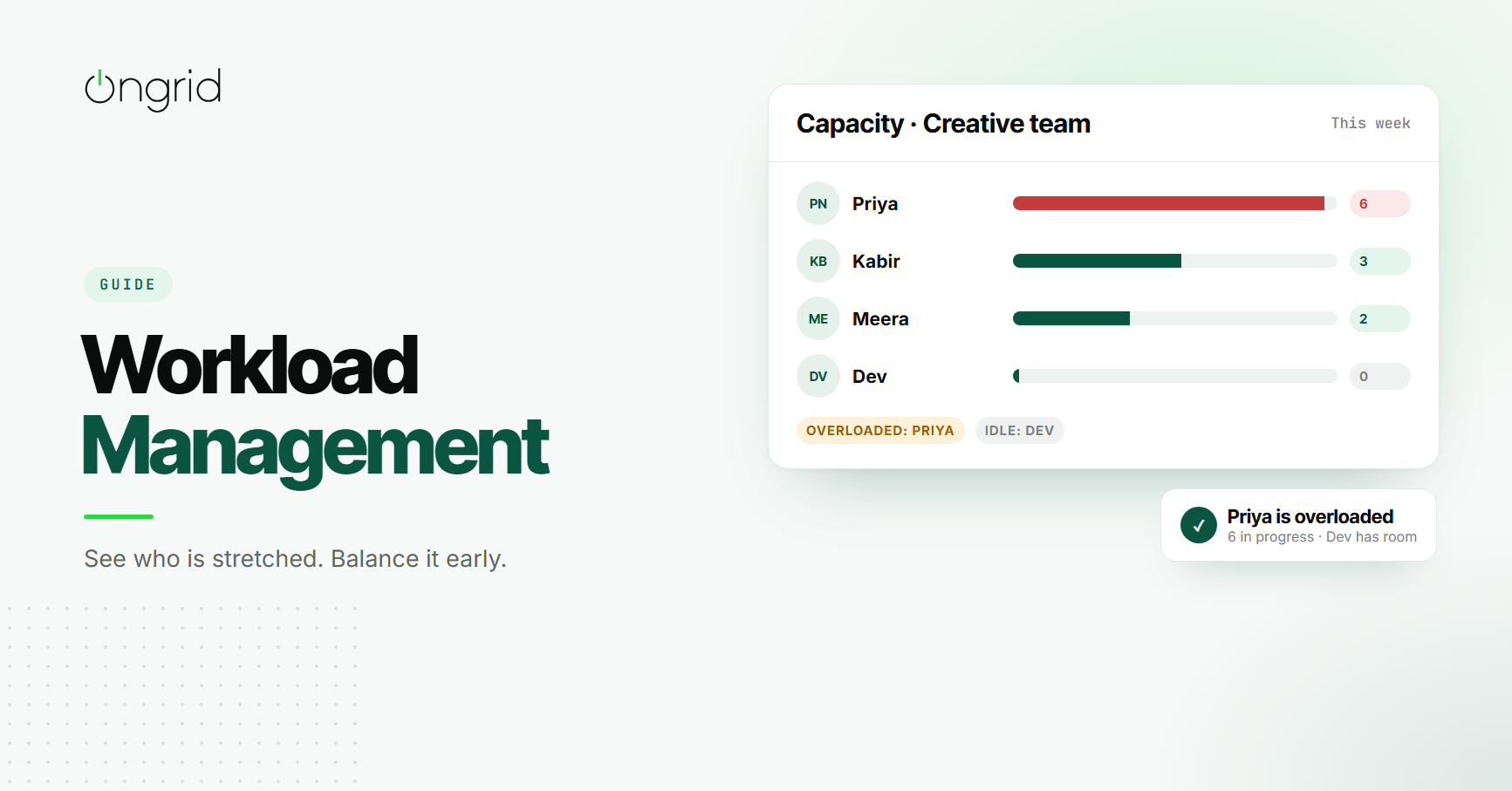
The number does not need to be scientific. The point is to have a line, so that "Priya has six things in progress" becomes an obvious flag instead of something you notice after the damage is done.
3. Review the Spread Every Week
Spend fifteen minutes every Monday looking at the whole team, not individual tasks. Who is above the limit? Who has nothing in progress? Which deadlines this week depend on the same person?
Doing this before new work is assigned is the key. It is much easier to give a new brief to the person with room than to take work away from someone who is already halfway through it.
4. Move Work Early, Not at the Deadline
When someone is overloaded, act while there is still time. Move a task to a teammate with capacity, push a lower-priority deadline, or split a large job between two people.
Waiting until the day before a deadline to rebalance does not help anyone. By then, the overloaded person has spent days context-switching between everything and the new owner has no time to do it properly. If you need help deciding what gives way, our guide on how to prioritise tasks in an agency covers it.
5. Look at Idle Time as Well as Overload
Someone with no active work is also a workload problem. It may mean they are blocked, waiting for a client, or simply being overlooked when work is assigned. Ask before assuming they are free. Then route the next suitable task their way.
6. Balance the Type of Work, Not Just the Amount
Two people can have the same number of tasks and very different weeks. One has three easy resizes. The other has three new campaign concepts for demanding clients. When you rebalance, think about effort and stress, not just the count.
It also helps to rotate the difficult clients and the tedious work, so the same person does not always get stuck with them.
7. Ask Directly, and Listen to the Quiet Answers
Data shows you where to look. Conversation tells you what is actually happening. In one-to-ones, ask "what is taking up most of your energy right now?" rather than "how is everything going?"
Pay attention to the person who always says "it's fine". Long hours, slower replies and small mistakes from someone usually reliable are early warning signs of occupational burnout, and they show up well before anyone says they are struggling.
Managing Workload During Busy Seasons
For many Indian agencies, the period from Navratri to Diwali is the hardest stretch of the year. Every client wants festive campaigns, all with the same deadlines.
A few habits make that season far more manageable:
Plan festive work a month early. Collect briefs in September, not the week before Diwali. A clear creative brief for each campaign saves days of back-and-forth later.
Stagger deadlines across clients. Not every client needs final artwork on the same day. Negotiate a spread while there is still room to do so.
Check the spread twice a week. A weekly review is not enough when deadlines move daily.
Plan the recovery. After a heavy season, protect people's time for a few days. Fewer meetings, no new pitches, a lighter load.
Common Mistakes When Balancing Workload
Measuring hours instead of work. Long hours are a symptom of overload, not a measure of productivity.
Rewarding the people who never say no. If your best people always get the extra work, you are training them to burn out.
Rebalancing only when someone complains. By the time someone raises it, they have usually been overloaded for weeks.
Treating every task as the same size. A logo refresh and a caption edit are not equal, even if both are "one task".
How OnGrid Helps With Workload Management
OnGrid has a dedicated Capacity view that shows how work is distributed across your team. Directors see the split by team and can drill into any department, while team leads see each member of their own team, with tasks broken down into backlog, in progress and done.
OnGrid also flags imbalance for you. Anyone with four or more tasks in progress is listed as overloaded, and anyone with nothing in progress is listed as idle, so the weekly review starts with the people who need attention instead of a long list of tasks.
Because the view is built from the tasks your team already updates, there is no separate spreadsheet to maintain. And since tasks, deadlines and projects live in the same place, it is easy to see what to move once you know who has room. If you also want to cut down on status check-ins, read our guide on how to stop chasing your team for task updates.
Final Thoughts
Workload management is not about squeezing more out of people. It is about making sure the work you already have is shared in a way your team can keep up.
See work in progress per person, agree on a simple limit, review the spread every week and move work before deadlines slip. Watch the quiet signals from your most reliable people.
Do that consistently, and the next time someone says "all good" in a stand-up, you will actually know whether it is true.
Frequently asked questions
1. What is workload management?
Workload management is how a team plans, distributes and monitors work so that each person has a realistic amount to do. It covers assigning work, tracking what is in progress, and moving tasks when someone has too much or too little.
2. How do you know if an employee is overloaded?
Look at how many tasks they have in progress at once, how often their deadlines slip, and whether they are regularly working late. A person with four or five active tasks across different clients is usually stretched, even if they say they are fine.
3. How often should managers review team workload?
A short weekly review works for most small teams, ideally on Monday before new work is assigned. Busy periods, like festive campaigns or product launches, may need a quick mid-week check as well.
4. What is the difference between workload management and capacity planning?
Capacity planning looks ahead at how much work the team can take on over the coming weeks or months. Workload management is about the work already on people's plates right now and keeping it balanced.
5. How can workload management prevent burnout?
Burnout usually builds slowly when the same people carry too much for too long. Making workload visible, limiting work in progress and rebalancing early stops that pattern before it becomes a resignation letter.