Sales Follow Up: How to Chase Leads Without Being Annoying
By Gaurav Sharma · 15 October 2026 · 7 min read
In short
- Good sales follow up is planned, not remembered. Agree the next step on every call, follow up within a day, space later messages out, add something useful each time, and close the loop politely when a lead goes cold. Track every lead with an owner and a next follow-up date so nothing goes quiet without someone noticing.
The proposal went out on a Monday. The call before it had gone well. The client said the scope made sense and they would "discuss internally and come back by Friday".
Friday came and went. The account manager meant to send a reminder, but two client deliverables were due and it slipped to the next week. By the time someone wrote, the client had already signed with another agency. Not because the other proposal was better. Because they were the ones who kept the conversation going.
Most lost deals look like this. Nobody says no. The lead just goes quiet, and nobody notices until it is too late to matter.
A good sales follow up routine fixes the part of selling that has nothing to do with your pitch. Below is how to time your follow-ups, what to say in each one, example messages you can adapt, and how to know when to stop.
What Is a Sales Follow Up?
A sales follow up is any contact you make with a lead or prospect after the first conversation to move the deal to its next step. That could be a call after a discovery meeting, an email after a proposal, or a short message checking whether the decision maker has had a look.
The key word is next step. A follow-up that only asks "any update?" puts all the work on the client. A useful one reminds them where things stand and makes the next move easy.
Why Leads Go Quiet
Before fixing your follow-ups, it helps to be honest about why replies stop. It is rarely because the client has decided against you.
Nobody Agreed on the Next Step
The call ends with "sounds great, let's stay in touch". There is no date, no owner and no clear action. Both sides assume the other will move first.
You Are Not Talking to the Decision Maker
The marketing executive loved the proposal, but the founder signs the cheques and has not seen it yet. Your follow-ups keep landing with someone who cannot say yes.
The Follow-Up Depends on Someone Remembering
When the next contact lives in a notebook, a personal reminder or someone's head, it gets pushed back every time client work gets busy. Which is always.
Every Message Says the Same Thing
"Just checking in" three times in a row gives the client nothing new to respond to. It is easy to ignore, and slightly easier each time.
When to Follow Up: A Simple Timeline
There is no perfect schedule, but spacing matters more than people think. Too close together feels like pressure. Too far apart and the client forgets the conversation. This pattern works for most agency and B2B deals:
Same day or next working day: a short recap of the call and the agreed next step.
Two to three working days after the proposal: check it arrived and offer to walk through it.
About a week later: share something useful, such as a relevant example or an answer to a concern they raised.
Two weeks later: a direct question about timing or the decision.
A week or two after that: a polite closing message if there is still no reply.
Adjust it to the deal. A large retainer with several stakeholders will move slower than a one-off design job, and that is fine as long as the next follow-up date is always written down.
How to Write a Sales Follow Up That Gets a Reply
1. Lead With Context
Your client is juggling a dozen vendors. Open with one line that reminds them who you are and what you discussed. "Following up on Tuesday's call about the website revamp" does the job.
2. Add Something New Every Time
Each message should give the client a reason to reply that the last one did not. A short case study from a similar business, a revised timeline, an answer to the budget question they raised. If you have nothing new to add, wait.
3. Ask One Clear Question
"Let me know your thoughts" is easy to postpone. "Would Thursday or Friday work for a 15-minute call with Rohan?" is easy to answer. Make the reply a single click or a single word.
4. Keep It Short
Most follow-ups are read on a phone between meetings. If it needs scrolling, it will be saved for later, and later rarely comes.
5. Match the Channel to the Relationship
Email works for proposals and anything that needs a record. A phone call works better when something is stuck. A WhatsApp message can be fine for a client who already talks to you that way, but do not switch channels just to get attention.
Example Sales Follow-Up Messages
Adapt these to your own voice. The structure matters more than the exact words.
After a Discovery Call
Hi Priya, thanks for the time today. To recap: you want the new site live before the March launch, with product pages your team can update themselves. I will send a proposal with two options by Thursday. Is there anyone else who should see it before you decide?
After Sending a Proposal
Hi Priya, just making sure the proposal reached you. Happy to walk Rohan and you through it in 20 minutes if that is easier than reading it. Would Wednesday afternoon work?
When Adding Something Useful
Hi Priya, you mentioned your team worries about updating the site after launch. Here is a two-minute video of how a similar client edits their product pages. Does that answer the concern, or is there more we should cover?
The Closing Message
Hi Priya, I have not heard back, so I will assume the timing is not right and close this on our side for now. If things change before March, just reply here and we will pick it up from where we left off.
The closing message often gets more replies than any other. It is polite, it removes the pressure, and it gives the client an easy way to say "actually, we are still interested".
Common Sales Follow Up Mistakes
Waiting for the client to come back. If you agreed they would reply by Friday and they did not, it is your move on Monday.
Following up with the wrong person. Ask early who else is involved in the decision, and find a way to reach them.
Sending the same message again. If the last email did not get a reply, a copy of it will not either.
Never closing the loop. A lead that has gone quiet for two months is not a pipeline. It is a guess. Close it and move on.
Keeping follow-ups in personal reminders. When a salesperson is on leave or moves on, their follow-ups disappear with them.
Build a Follow-Up Routine Your Team Can Keep
Individual messages matter less than the habit behind them. A routine that does not depend on memory looks like this:
Every lead and deal has one owner.
Every call ends with a next follow-up date, recorded straight away.
Every morning, each person checks what is due today and what is overdue.
Once a week, the team reviews deals and leads that have had no updates for about seven days.
This is the same thinking behind good task management. If you have already worked on not chasing your team for task updates, the principle is identical: make the status visible so nobody has to rely on memory. And once a deal is won, a clear client onboarding checklist keeps that momentum going into delivery.
If you want to go further, lead management as a discipline covers how leads are captured, qualified and handed between people, which is where many follow-up problems actually start.
How OnGrid Helps Teams Follow Up on Time
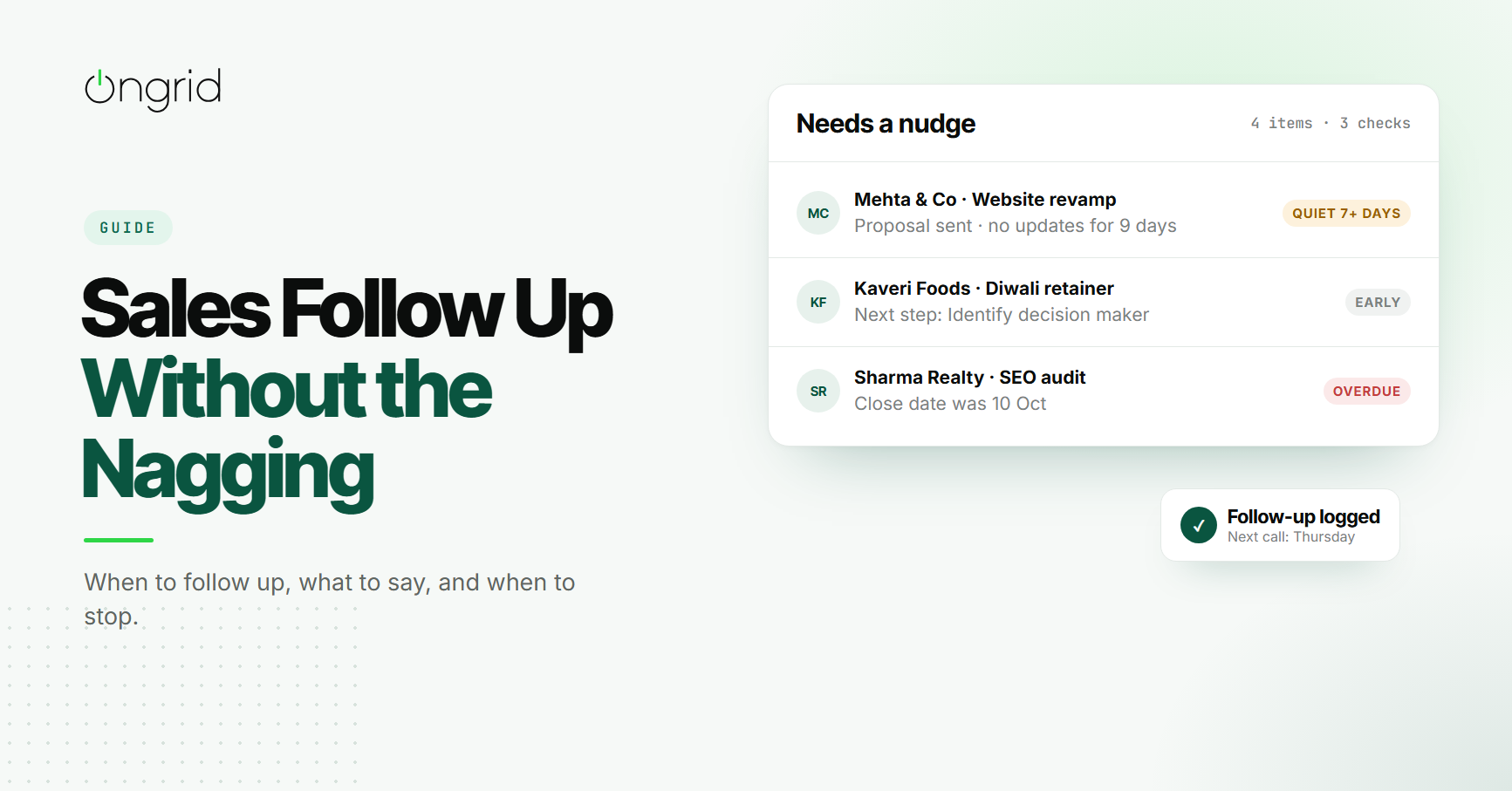
OnGrid's CRM is built around not letting deals go quiet. The CRM overview has a Needs a nudge card that lists deals and leads with no updates for seven days or more, deals past their expected close date, deals that are not yet qualified, and, for managers, deals and leads without an owner.
Follow-ups are scheduled against the deal and shown as Today, Overdue and Upcoming, so each person starts the day knowing exactly who to contact. Completing one takes a click.
Each deal tracks BANT qualification (budget, authority, need and timeline) and suggests the next thing to find out, such as "Identify decision maker" when nobody knows who signs off. Calls, emails, meetings and notes all sit on one timeline.
If your team uses Zoho Mail, you can connect it, send emails from the deal using saved templates, and keep the conversation attached to the right client. When a deal is won, you can turn it into a project in the same workspace, so the handover to delivery does not start from scratch.
Final Thoughts
Most deals are not lost to a better pitch. They are lost to a week where nobody followed up.
Agree the next step on every call. Follow up quickly, space later messages out, and add something useful each time. Ask one clear question, and close the loop politely when a lead goes cold.
Above all, take follow-ups out of people's heads and put them where the whole team can see them. That one change does more for your close rate than any perfectly worded email.
Frequently asked questions
1. How soon should you follow up after a sales call or proposal?
Within one working day for a call, and two to three working days after sending a proposal. The first follow-up should confirm what was agreed and the next step, not just ask whether they have had a chance to look.
2. How many times should you follow up with a lead?
There is no fixed number. A practical pattern is four or five touches spread over three to four weeks, each adding something new, followed by a polite closing message if there is still no reply.
3. What should a sales follow-up message include?
A reminder of the context, one useful piece of information or a direct answer to their concern, and a single clear question or next step. Keep it short enough to read on a phone.
4. Is it rude to follow up when a client has not replied?
No. Most people are busy rather than uninterested, and a polite reminder is usually welcome. It only becomes annoying when the messages repeat the same ask without adding anything.
5. How do you keep track of sales follow-ups across a team?
Give every lead and deal an owner and a next follow-up date in a shared CRM, and review anything that has had no activity for about a week. Spreadsheets and personal reminders break down once more than one person is selling.