Agency Profit Margin: How to Calculate It, What Is Good and How to Improve It
By OngridWork · 24 November 2026 · 6 min read
In short
- Agency profit margin is the share of revenue left after costs. Track three versions: project margin, gross (delivery) margin and net margin. Many agencies earn roughly 13 to 20 percent net, though reported benchmarks vary. The fastest ways to improve it are to price against hours, control scope, raise utilisation, retire unprofitable clients, improve estimates and collect payments on time.
Many agency owners can tell you last month's revenue but not their agency profit margin, and that gap is where profit quietly disappears. A busy team, a full client list and growing revenue can all coexist with a margin that is shrinking, because every unpaid revision and every underestimated project costs more than it brings in. This guide explains how to calculate your agency profit margin at three levels, what a good number looks like, and six practical ways to raise it, with worked examples in rupees.
What is agency profit margin?
Agency profit margin is the percentage of your revenue that remains as profit after you subtract costs. A 20 percent margin means that for every ₹100 a client pays, you keep ₹20 after paying for the people, tools and overheads that delivered the work. It matters more than revenue because it tells you whether your growth is paying for itself.
What are the three margins every agency should track?
Each margin answers a different question, so you need all three.
Margin | Formula | What it tells you |
|---|---|---|
Project margin | (Project fee − cost of hours worked) ÷ Project fee | Whether one client project made or lost money |
Gross (delivery) margin | (Revenue − direct delivery costs) ÷ Revenue | How efficiently your team turns time into revenue |
Net margin | (Revenue − all costs) ÷ Revenue | Whether the whole business is profitable after overheads |
An agency can have a strong gross margin and still lose money overall if overheads such as rent, tools and admin are too high. Looking at only one number hides the problem.
How do you calculate agency profit margin?
Start with the agency level, then move to a single project.
Agency level (one year). Suppose your agency earns ₹40,00,000 in revenue. Direct delivery costs, meaning the salaries of people who work on client projects plus freelancers, come to ₹22,00,000. Overheads such as rent, software, admin and marketing come to ₹12,00,000.
Gross margin = (₹40,00,000 − ₹22,00,000) ÷ ₹40,00,000 = ₹18,00,000 ÷ ₹40,00,000 = 45 percent
Net profit = ₹18,00,000 − ₹12,00,000 = ₹6,00,000
Net margin = ₹6,00,000 ÷ ₹40,00,000 = 15 percent
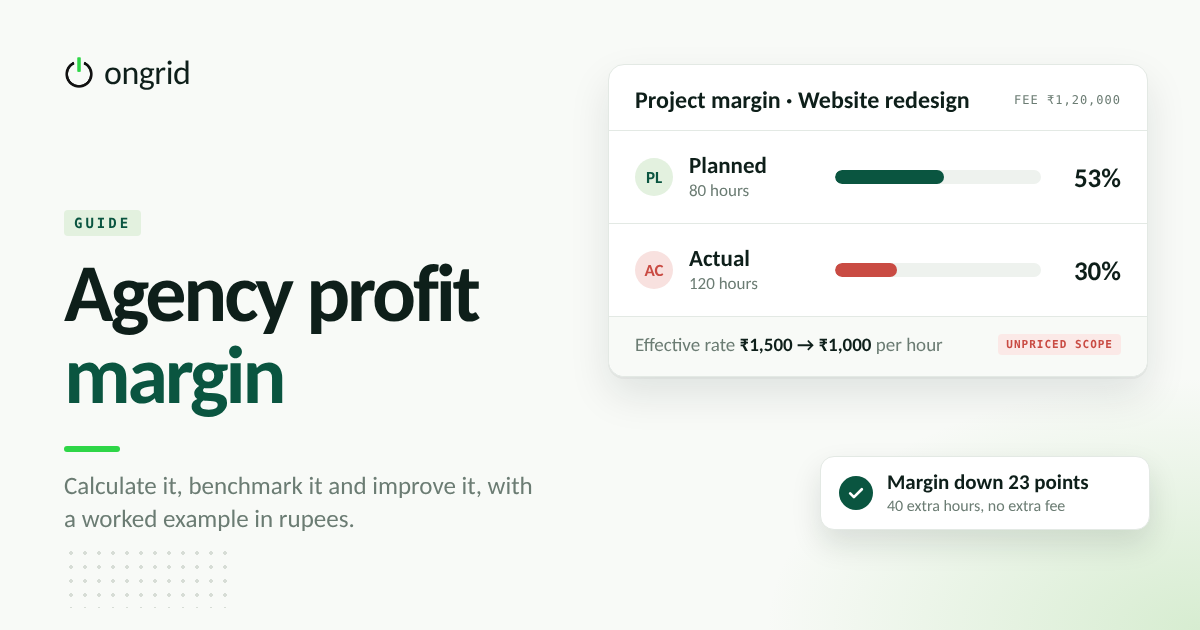
Project level. Suppose you charge ₹1,20,000 for a project and estimate 80 hours, with a loaded cost of ₹700 per hour (salary plus a share of overheads).
Planned cost = 80 × ₹700 = ₹56,000, so planned margin = (₹1,20,000 − ₹56,000) ÷ ₹1,20,000 = 53 percent
The project actually takes 120 hours because of extra revisions. Actual cost = 120 × ₹700 = ₹84,000, so actual margin = (₹1,20,000 − ₹84,000) ÷ ₹1,20,000 = 30 percent
Nothing about the fee changed, but 40 extra hours cut the margin by 23 points and the effective rate fell from ₹1,500 to ₹1,000 an hour. That is what scope creep does, and it is why our guide to scope creep in agencies matters for profit and not only for deadlines.
What is a good agency profit margin?
It depends on size, specialty and who you ask, so treat benchmarks as a range, not a target. One summary of Promethean Research's 2026 report puts the average agency net margin at about 13 percent in 2025, with studios under ten people near 19 percent and agencies of 50 or more people near 8 percent. Other agency finance sources report higher figures: a consultant quoted by Resource Guru says most healthy agencies sit around 20 percent net, within a range of 15 to 30 percent. bsscommerce
Source | Net margin figure |
|---|---|
Promethean Research (as summarised), average in 2025 | About 13 percent |
Same data, studios under 10 people | About 19 percent |
Same data, agencies of 50 or more | About 8 percent |
Resource Guru, healthy agencies | About 20 percent, range 15 to 30 percent |
These figures come mainly from US and global surveys, not Indian agencies, and they define costs differently, so they are context and not a standard. The most useful comparison is your own margin over time: if it is rising, you are improving, and if it is falling while revenue grows, something in your pricing or scope control is leaking.
Why do agency margins shrink?
Five causes account for most of it:
Unpaid extra work. Revisions and add-ons beyond the agreed scope.
Underestimated projects. Fees set from guesswork, not from past hours.
Low utilisation. If people are billable for 50 percent of their time, the other 50 percent is a cost.
Unprofitable clients. A few demanding clients often absorb disproportionate time.
Late payments. Cash tied up in unpaid invoices forces you to borrow or delay costs.
How do you improve agency profit margin?
Six changes, in the order most agencies see results.
Price against hours, not feel. Estimate with past project data, add a buffer, and set the fee so your planned project margin is comfortably above your target. If a project is estimated at 80 hours, do not quote for 80.
Control scope. Write what is out of scope at kickoff, and price every extra request with a change request. Our client kickoff meeting agenda includes a ten-minute scope section for this.
Raise utilisation. Compare billable hours with available hours for each person. If the team has spare capacity, sell more. If people are overloaded, quality and margins both suffer. Seeing workload across the team before you commit to new work helps, and it is what OnGrid's workload heatmap is for.
Retire or reprice your least profitable clients. Rank clients by project margin. If the bottom clients consistently lose money, raise their fees, tighten their scope, or let them go.
Learn from every project. Compare planned and actual hours in a project retrospective, and feed the results into your next estimate.
Collect on time. Invoice on delivery, send reminders on a schedule, and ask for an advance on larger projects. A profitable project that is paid 90 days late still strains your cash flow.
How do you track agency profit margin every month?
Keep it simple: a one-page review in your weekly review meeting and a fuller monthly check. Track five numbers: revenue, direct delivery costs, billable utilisation, margin per client, and overdue invoices. A short monthly review catches a shrinking margin in weeks, not at year-end. If you are choosing tools for this, our guide to project management software for agencies in India shows what to look for.
Copy-and-paste agency margin worksheet
AGENCY MARGIN REVIEW: [Month / Quarter]

Revenue:
Direct delivery costs (delivery salaries, freelancers):
Gross margin = (Revenue - delivery costs) / Revenue =        %

Overheads (rent, tools, admin, marketing):
Net profit = Revenue - delivery costs - overheads =
Net margin = Net profit / Revenue =        %

Utilisation = billable hours / available hours =        %

PROJECT MARGIN (per project)
Client / project:
Fee:
Planned hours / actual hours:
Loaded cost per hour:
Project margin = (Fee - actual hours x cost per hour) / Fee =        %
Effective rate = Fee / actual hours = ₹        per hour

Bottom 3 clients by margin:
Actions this month (max 3, with owner and date):
What mistakes should you avoid?
Confusing revenue with profit. Growth in revenue says nothing about margin.
Ignoring overheads. Gross margin alone can hide a loss.
Using salary only as cost. Include a share of overheads in your hourly cost, or your margin will look better than it is.
Copying a benchmark blindly. Your size, service mix and city all change what is realistic.
Reviewing annually. By the time you see the problem, a year of work is gone.
Frequently asked questions
What is a good profit margin for an agency?
Reported net margins vary widely, from around 13 percent as an average in one set of research to 15 to 30 percent as a healthy range in others. Smaller studios tend to earn higher margins than large agencies. Compare your own margin over time first.
How do you calculate agency profit margin?
Subtract your total costs from your revenue to get net profit, divide net profit by revenue, and multiply by 100. For one project, use the project fee minus the cost of the hours worked.
What is the difference between gross margin and net margin for an agency?
Gross margin subtracts only direct delivery costs, such as delivery salaries and freelancers. Net margin subtracts all costs, including overheads such as rent, tools and admin.
How can a small agency increase profit margin quickly?
Control scope, price extra work with change requests, and review your least profitable clients. These usually produce faster results than cutting costs or finding new clients.
What is utilisation rate in an agency?
Utilisation rate is billable hours divided by available working hours. If a person has 160 available hours in a month and 112 are billable, their utilisation is 70 percent.