Creative Brief Template: How to Write a Brief Your Team Can Actually Use
By Gaurav Sharma · 15 October 2026 · 7 min read
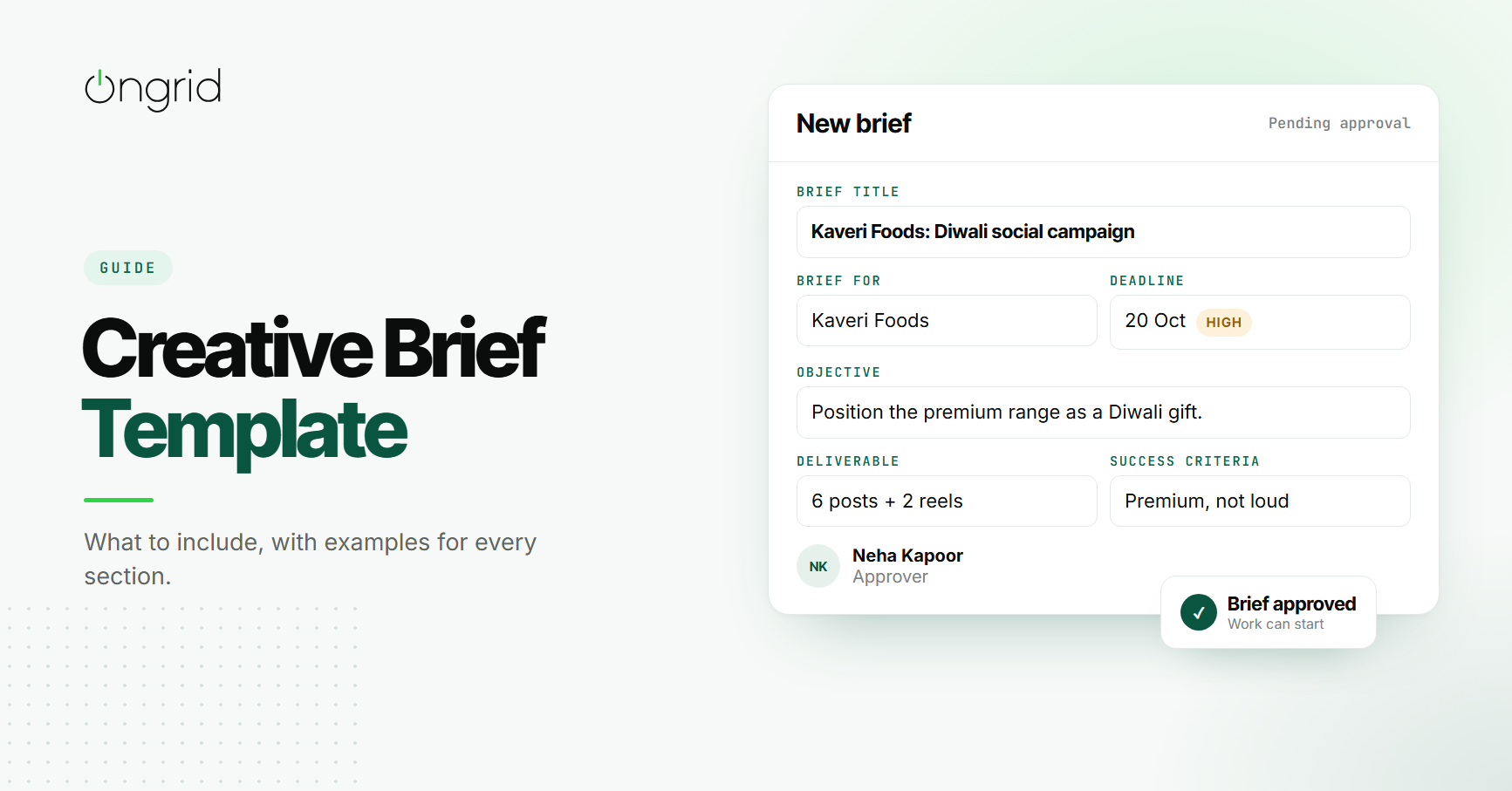
In short
- A good creative brief answers what you are making, for whom, why, by when and how you will know it worked, before anyone starts. Use the 12-section template in this guide, fill in one concrete example per section, name a single approver, and do not start work until the brief is approved.
It is 7:40 on a Tuesday evening. The account manager forwards a voice note from the client, adds "can we start on this tomorrow?" and logs off.
The designer listens to it twice the next morning, makes a reasonable guess, and spends two days on concepts. On Friday the client replies: "This isn't really what we discussed."
Nobody did anything wrong, exactly. The brief just never existed in one place. Half of it was in the voice note, some of it was in an old email thread, and the most important part, what the client actually wanted to achieve, was never written down at all.
A creative brief template fixes this by forcing those decisions to happen before the work starts, not after the first round of feedback. Below is the template we recommend, what to write in each section, and a filled-in example you can copy.
What Is a Creative Brief?
A creative brief is a short document that explains what a piece of creative work needs to achieve, who it is for, what exactly needs to be delivered, and when. It is the agreement between the client, the account team and the people doing the work.
It is not a contract and it is not a strategy deck (Wikipedia's overview covers its history in advertising). A good one fits on one or two pages and can be read in five minutes.
Why Most Creative Briefs Fail
Agencies rarely skip briefs completely. The problem is usually that the brief exists but does not do its job.
It Gets Written After the Work Starts
When deadlines are tight, the team starts on whatever they know and plans to "tidy up the brief later". Later never comes, and the brief ends up describing what was made rather than what was needed.
It Describes the Client, Not the Job
Three paragraphs about the company's history and values, and one line about the actual deliverable. The designer finishes reading it knowing a lot about the brand and very little about what to make.
Nobody Defines What "Done" Looks Like
"Make it premium" is a feeling, not a finish line. Without success criteria, every review becomes a matter of taste, and the revisions keep coming.
Nobody Owns the Approval
If the brief is never formally approved, nobody can point to it when the client changes direction. It becomes a suggestion instead of an agreement.
The Creative Brief Template
Copy these twelve sections into your own document or project tool, or save this creative brief template as the default for every new project. For each one, we have added what to write and a short example from a fictional festive campaign for a food brand.
1. Brief Title
Name the client and the job so the brief is easy to find later. Avoid titles like "New campaign" or "Urgent".
Example: Kaveri Foods: Diwali social campaign 2026
2. Client and Brand
Which client, and which brand or product line if they have more than one. This matters more than people expect for clients with several sub-brands.
Example: Kaveri Foods, premium snacks range
3. Background
Two or three sentences on why this work is happening now. What changed, what has been tried before, and what the client is worried about.
Example: Last year's Diwali posts performed well on reach but felt similar to every other snack brand. The client wants this year to feel more premium and less discount-led.
4. Objective
One clear sentence about what the work needs to achieve. If you find yourself writing three objectives, pick the one that matters most and move the others to the notes.
Example: Position the premium snacks range as a Diwali gifting option on Instagram.
5. Target Audience
Be specific enough that the team can picture one real person. Age ranges alone are not very useful.
Example: Urban professionals aged 28 to 40 who buy Diwali gifts for colleagues and family, and usually default to dry fruits or sweets.
6. Deliverables
List exactly what will be produced, including formats, sizes and quantities. This is the section that prevents most scope arguments.
Example: 6 Instagram feed posts (1080 x 1350) and 2 reels (up to 30 seconds), with captions.
7. Key Message
The one thing you want the audience to remember. If you cannot say it in a single sentence, the creative will struggle to say it at all.
Example: A Kaveri gift box says you put thought into it.
8. Tone and Mandatories
How the work should feel, plus anything that must or must not appear: logos, legal lines, colours, words the client hates.
Example: Warm and premium, not loud. No discount messaging. Logo on every post. Avoid gold-heavy visuals the client used last year.
9. Success Criteria
How you and the client will decide the work is right. Mix quality bars with anything measurable.
Example: Client signs off on the concept in one round. Posts follow the new brand guidelines. Save rate higher than last year's Diwali posts.
10. Deadline and Milestones
The final date, plus the review points in between. Work backwards from the launch date and leave room for at least one revision round.
Example: Concepts by 10 Oct, first drafts by 14 Oct, final approval by 20 Oct, posts go live from 24 Oct.
11. Budget
Include it if it affects the work, such as shoots, stock images or paid promotion. If the client has not confirmed a number, write that down rather than guessing.
Example: Same as last year's campaign. Figure to be confirmed by the client.
12. Approver, Reviewer and References
Name one person who approves the brief and the final work, and one person who reviews it internally. Then link everything the team needs: brand guidelines, previous campaigns, mood boards and examples the client likes.
Example: Approver: Neha (client marketing head). Internal reviewer: Arjun (creative lead). References: brand guidelines PDF, last year's posts, three competitor posts the client likes.
What a Finished Brief Looks Like
Put together, the filled-in creative brief template above reads like this:
Kaveri Foods: Diwali social campaign 2026. Position the premium snacks range as a thoughtful Diwali gift for urban professionals aged 28 to 40. Deliver 6 Instagram posts and 2 reels with captions. Key message: a Kaveri gift box says you put thought into it. Warm, premium tone, no discount messaging. Final approval by 20 Oct from Neha, reviewed internally by Arjun.
If someone new joined the project tomorrow, they could read that paragraph and know what to do. That is the test every brief should pass.
Common Creative Brief Mistakes
Copying the client's email into the brief. The client brief is raw material. The creative brief is your team's interpretation of it, checked back with the client.
Leaving deliverables vague. "Some social posts" will turn into a debate about whether stories were included.
Skipping the audience because "the client knows who they are". The client might. The designer usually does not.
Too many objectives. Awareness, engagement, sales and brand love all at once means none of them guide the work.
No single approver. When three people on the client side can approve, you will get three sets of feedback.
Get the Brief Approved Before Work Starts
The most useful habit you can build is simple: no brief, no work. And not just any brief, an approved one.
Once the brief is written, send it to the named approver and ask for a clear yes or no. If something is unclear, it should come back with a reason, such as "the success criteria need a number" or "we have not agreed on the budget", not a vague "let's discuss on a call".
This takes a day at most, and it gives your team something solid to point to when the direction changes three weeks later. Because it usually does. The same thinking applies to the work itself, which is why a clear client approval process is the natural next step after an approved brief.
How OnGrid Helps Agencies Manage Briefs
OnGrid has a dedicated Briefs module built around one rule: no work starts without a complete, approved brief.
Each brief captures who it is for, the brand, priority and deadline, the objective, the deliverable and the success criteria. Every brief names an approver and a reviewer, and if it is rejected, the person rejecting it has to give a reason so the author knows exactly what to fix.
You can attach reference links and files, and link a brief to the projects it drives. Everyone working on those projects can then read it, so the team is always working from the same version.
The rest of the work lives in the same place: tasks, approvals, files and team workload (see our guide to agency workflow management), so the brief does not get separated from the work it describes.
Final Thoughts
A creative brief is not paperwork. It is the cheapest point in a project to fix a misunderstanding.
Use the twelve sections of this creative brief template, write one concrete example in each, and keep the whole thing to a page or two. Name one approver, get a clear yes, and only then open the design file.
Your designers will thank you, and your revision rounds will get a lot shorter.
Frequently asked questions
1. What should a creative brief include?
At minimum: the client and brand, a short background, the objective, the target audience, the exact deliverables, the key message, tone and mandatory elements, success criteria, deadlines, budget, the approver, and links to reference material.
2. How long should a creative brief be?
Usually one to two pages. If it runs longer, the extra detail probably belongs in an attachment. If it is only a few lines, important decisions are being left for later.
3. Who writes the creative brief in an agency?
Usually the account or project manager, using information from the client. The creative lead should review it before it is approved, because they are the person who has to execute against it.
4. What is the difference between a client brief and a creative brief?
A client brief is what the client sends you, in whatever form it arrives. A creative brief is the agency's version: cleaned up, filled in and agreed, so the team has one clear document to work from.
5. How do you get clients to fill in a brief?
Make it short, send it as a form with examples in each field, and fill in what you already know before sending it. Most clients are happy to correct a draft. Very few enjoy a blank page.