Agency Workflow Management: A Complete Guide
By Gaurav Sharma · 12 October 2026 · 9 min read
In short
- Agency workflow management helps teams organize briefs, tasks, deadlines, approvals, and responsibilities in one clear process. Learn how to build efficient workflows, reduce delays, improve team collaboration, track workloads, and keep agency projects moving smoothly as your business grows.
Agency work rarely happens in a straight line. A client shares a brief, a team starts working on it, feedback comes in, deadlines change, and someone needs to approve the final deliverable. Meanwhile, other projects are moving forward at the same time.
When everything is connected through a clear process, managing this work is fairly straightforward. But when tasks live in spreadsheets, updates are buried in chats, and approvals depend on follow-up messages, even a small project can become difficult to manage.
This is where agency workflow management becomes important. It helps agencies organize how work moves from the initial request to the final delivery, making responsibilities, deadlines, and progress easier to track.
In this guide, we'll look at how agency workflows work, why they break down, and how to build a system that keeps projects moving without unnecessary delays.
What Is Agency Workflow Management?
Agency workflow management is the process of organizing, assigning, tracking, and completing work across an agency.
It defines how a task moves from one stage to another, who is responsible for it, what needs to happen next, and who needs to review or approve the result.
For example, a marketing agency working on a client's social media campaign might follow this workflow:
The client shares the campaign requirements.
The account manager prepares the brief.
The team assigns tasks to designers and copywriters.
The team creates the content.
A manager reviews the work.
The client provides feedback or approval.
The team makes any required revisions.
The final content is scheduled or delivered.
Each stage has a purpose. Everyone knows what they're responsible for, and the next person can pick up the work when it's ready.
Without a defined workflow, the same process might involve several messages, repeated questions, missed feedback, and confusion about whether the work is actually finished.
Why Do Agency Workflows Break Down?
Most agencies already have some kind of workflow, even if they haven't formally documented it. The trouble is that the process often depends on people remembering what to do next.
As the agency grows, this becomes harder to maintain.
1. Work Is Scattered Across Different Tools
A project brief might be in email, the files in Google Drive, task updates in a chat group, and approval feedback in another conversation.
Team members spend time searching for information instead of working on the deliverable. New team members may struggle to understand the project because its context is spread across several places.
2. Nobody Has Clear Ownership
When a task is assigned to an entire team without a clearly responsible person, it becomes easy for everyone to assume someone else will handle it.
Every important task should have one accountable owner, even when multiple people contribute to the work.
3. Approvals Become Bottlenecks
A designer might finish a creative in the morning, but the work remains untouched until a manager reviews it. The manager may be waiting for the client, who is waiting for a revised version.
Without visibility into pending approvals, these delays often go unnoticed until the deadline is close.
4. Deadlines Don't Reflect Actual Workload
A team member might have several projects due on the same day. Each deadline may seem reasonable individually, but the combined workload might be unrealistic.
A workflow needs to account for both deadlines and available team capacity.
5. Revisions Keep Sending Work Backward
Feedback is a normal part of agency work. The problem starts when revision requests are unclear, old versions get mixed up, or nobody knows which changes are still pending.
A good workflow makes revisions visible and keeps the task moving toward completion.
How to Build an Effective Agency Workflow
You don't need a complicated process to manage agency work. You need a repeatable one that fits the way your team operates.
Here are the main steps.
1. Start With a Clear Project Brief
Every project should begin with a clear understanding of what needs to be delivered.
A useful brief includes:
Project objective
Expected deliverables
Assigned owner
Deadline
Success criteria
Relevant files and references
Review and approval requirements
For example, instead of assigning a task called "Create campaign creatives," specify how many creatives are required, which platforms they'll be used on, the expected dimensions, the deadline, and who will approve them.
This reduces assumptions and gives the team a shared understanding of the expected result.
2. Break Projects Into Manageable Tasks
Large deliverables often contain several smaller pieces of work. Keeping everything under one task makes progress difficult to measure.
Consider a website redesign. It might include research, wireframes, visual design, development, testing, revisions, and launch.
Each stage should have its own tasks, owners, and deadlines where appropriate.
Breaking work down helps managers identify delays earlier. If development hasn't started because the design hasn't been approved, the dependency becomes easier to spot.
3. Define Clear Task Statuses
A task needs more than a title and a due date. Its status should show where it currently stands.
A practical agency workflow might use these stages:
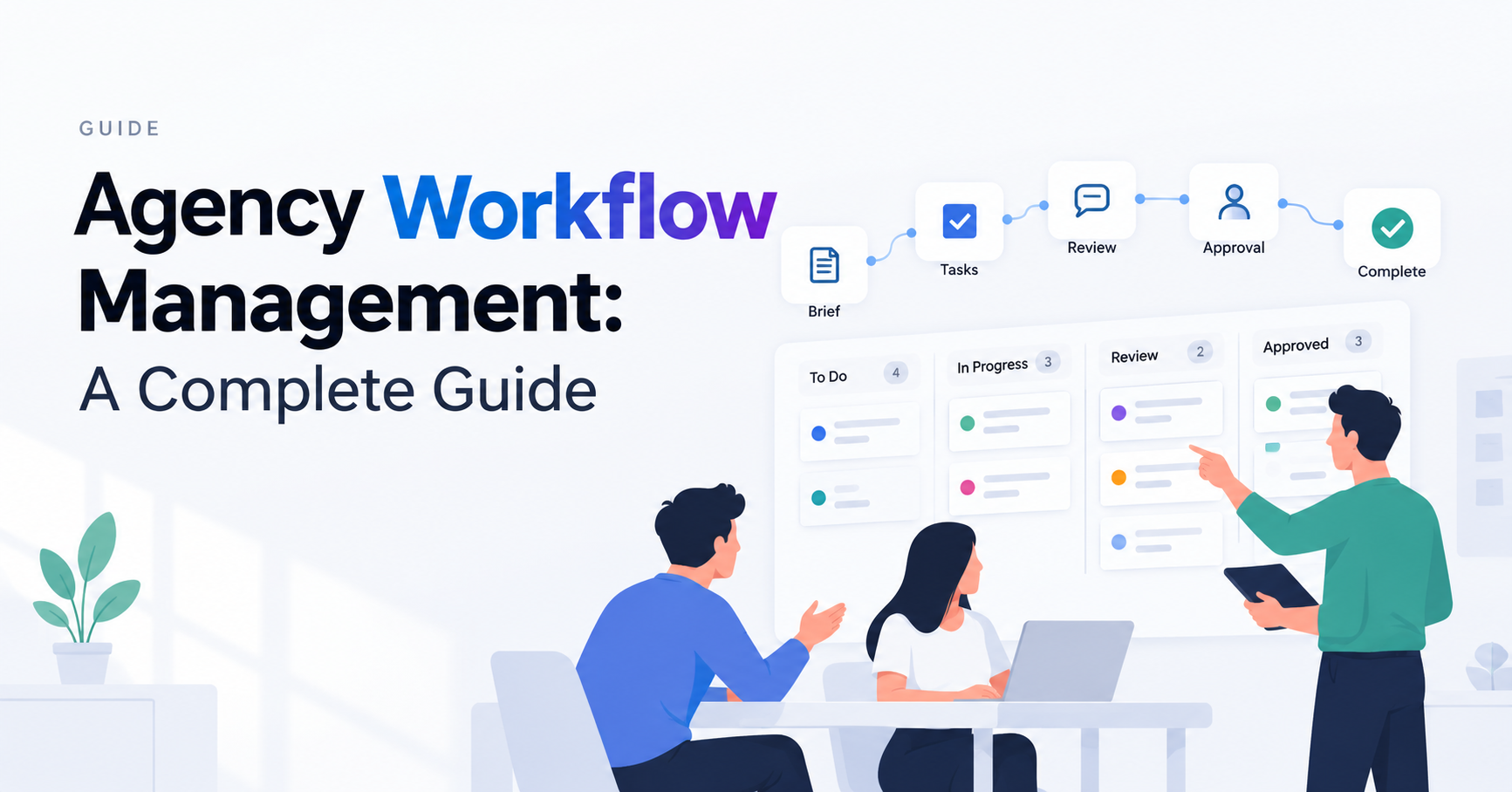
Backlog → In Progress → Submitted → Reviewed → Approved/Done
Backlog: The task is planned but hasn't started.
In Progress: Someone is actively working on it.
Submitted: The work is ready for review.
Reviewed: The work has been checked and is awaiting a final decision or next step.
Approved/Done: The deliverable has met the required criteria and is complete.
If revisions are needed, the task should return to the appropriate working stage with clear feedback.
The exact stages can vary by agency, but the important thing is that everyone understands what each status means.
4. Make Ownership and Deadlines Visible
Every task should have a responsible owner and a realistic deadline.
It should also be clear who is reviewing the work and whether another task must be completed first.
Managers should be able to identify overdue tasks, upcoming deadlines, blocked work, and tasks waiting for someone else's input.
This prevents a common situation where the team assumes everything is on track simply because nobody has raised a concern.
5. Create a Dedicated Approval Process
Approvals should be treated as a defined part of the workflow, not as an informal conversation.
For every approval, make it clear what is being reviewed, who is responsible for the decision, and what happens if changes are requested.
Feedback should be attached to the relevant task or deliverable wherever possible. This keeps the context together and makes it easier for the person doing the work to understand what needs to change.
It also helps managers distinguish between work that is unfinished and work that's complete but waiting for approval.
6. Keep Project Information Together
A team shouldn't need to search through multiple conversations to find the latest brief, file, SOP, or task update.
Keep relevant project information organized in one accessible place, including:
Tasks and subtasks
Project files
Standard operating procedures
Project members
Issues and blockers
Deadlines and progress
This is particularly useful when someone takes over a task or joins a project midway through its lifecycle.
A well-organized project gives them the context they need without requiring a long handover conversation.
7. Monitor Team Capacity Alongside Progress
Tracking task completion is useful, but it doesn't always tell you whether the team is working sustainably.
An agency manager should also understand how work is distributed across the team.
Review upcoming deadlines, current assignments, competing priorities, and available capacity before allocating additional work.
If a team member is overloaded, redistribute work early. If a project is at risk, identify the reason before the deadline passes.
The objective is to spot problems while there's still time to do something about them.
8. Establish a Simple Daily Update Routine
Daily updates help teams stay aligned, but they shouldn't require lengthy meetings or repeated status requests.
A simple daily check-in can cover three questions:
What has been completed?
What is being worked on next?
Is anything blocked or at risk?
Managers can use these updates to identify issues that need attention, while team members retain time for focused work.
The routine should create visibility, not become another administrative task.
How to Measure Whether Your Agency Workflow Is Working
A workflow can look organized on paper and still create unnecessary delays. Review a few practical indicators to understand how well it works.
Task completion: Are tasks being completed within their planned timelines?
Approval time: How long does work typically wait for review or client approval?
Revision frequency: Are deliverables repeatedly returning for changes because requirements were unclear?
Overdue work: Which tasks or projects regularly miss their deadlines, and why?
Team workload: Is work distributed reasonably, or are the same people consistently overloaded?
Project progress: Can managers identify which projects are on track, blocked, or at risk without asking everyone for updates?
These indicators help identify where a workflow needs improvement. The goal isn't to measure every possible activity. It's to understand where work slows down and what can be changed.
Common Agency Workflow Mistakes to Avoid
Even a well-designed process can become inefficient if it's too complicated or poorly maintained.
Watch out for these mistakes:
Creating too many statuses: Use stages that represent meaningful changes in the work.
Assigning tasks without context: Make sure the owner understands the deliverable and expected result.
Treating every message as a task: Turn actionable requests into trackable work instead of relying on chat history.
Ignoring approval delays: Track pending decisions just as carefully as active work.
Overloading team members: Check capacity before assigning more deadlines.
Building workflows nobody follows: Keep the process practical and adjust it based on how the team actually works.
Adding tools without connecting the process: More software won't automatically fix unclear ownership or fragmented information.
A good workflow should make work easier to manage, not introduce unnecessary steps.
What Should Agency Workflow Management Software Include?
Spreadsheets and general task boards can work well for small teams. As the agency grows, however, managing projects, people, approvals, and client operations separately becomes increasingly difficult.
Agency workflow management software can bring these processes together.
Look for a system that supports:
Project briefs and deliverables
Task and subtask management
Defined status workflows
Comments and revision tracking
Review and approval queues
Project files and SOPs
Team workload and capacity visibility
Deadline and risk tracking
Client and business management
Reporting and operational visibility
The most useful system is one that matches your actual workflow and gives each person the information they need for their role.
How OnGrid Helps Agencies Manage Workflows
OnGrid is built to help agencies manage work across projects, tasks, people, and business operations from one place.
Teams can start with structured briefs, turn deliverables into trackable tasks, and move work through defined stages from progress to review and approval.
Project boards, files, SOPs, issues, and todos keep relevant information connected to the work. Managers can also monitor project progress, pending approvals, team workload, and potential risks without relying entirely on manual follow-ups.
Beyond project execution, OnGrid brings together tools for client management, CRM, expenses, content planning, and team engagement.
The idea is straightforward: make work easier to track, make responsibilities clearer, and help teams identify problems before they become bigger delays.
Final Thoughts
Effective agency workflow management isn't about creating the perfect process on day one. It's about making sure work moves forward without depending on memory, constant reminders, or scattered conversations.
Start by clarifying briefs, assigning ownership, defining task statuses, and making approvals visible. Then improve the process by reviewing delays, workload, and recurring problems.
As your agency grows, the workflow should grow with it while remaining easy for the team to follow.
When everyone knows what needs to happen, who is responsible, and what comes next, managing agency work becomes a lot more predictable.